Showing posts with label Alpine County. Show all posts

Monday, March 30, 2026

Rediscovering Winter Wonderland in Hope Valley


Date: February 21, 2026
Place: Hope Valley, Markleeville, California
Coordinates:
Length: 1.9 miles
Level: Flat terrain but challenging deep fresh snow.
 
This recent winter has been strange here, in California. It started very early with several powerful storms in October, continued into November and December with great promise of a truly wet season and a superbloom year, and then dried up completely in January and the first half of February. The end of February saw the biggest storms yet, storms that dumped huge amount of snow in the mountains and caused some serious troubles there, including the deadliest avalanche in the history of Tahoe area. Nearly all of that snow is now gone, since that last storm was followed by the hottest heat wave ever recorded in March in those regions.  
I was looking for a window in my busy schedule and between the storms to go skiing. I found that window on Friday, February 20 right after the storm was finished. I hurried up the mountain as soon as the road was opened again and enjoyed a lovely skiing day in Kirkwood. The beautiful weather after the storm and the high fresh powder invited the multitudes of snow lovers to come as well, and the narrow and winding SR 88 was jam-packed with slow moving cars. I stayed that evening in Minden, NV, and decided that the following Saturday I'd go snow-shoeing instead of skiing again on all too crowded slopes. I looked up a few sno-parks along SR 88 and eventually stopped at my previous love of Hope Valley Wildlife Area. This time however, I didn't go on the usual trail I walk on but stopped at a pullout further west with the thought of exploring a different area of the valley.  
The 'Trail'head

There are several trails in Hope Valley, most of which are used by OHVs and in winter time - by snowmobiles. The snowmobile users were already crowing the Hope Valley Sno-Park area but there were none at the pullout where I stopped. There were only a few other cars parked there. My neighbor was preparing for back country downhill skiing on the wild slopes west of the road. I was preparing to snow-shoe on the flat area east of the road. I could see three small figures moving slowly eastward on what looked like a thin trail, and decided to follow them. 
My hike as captured by my GPS

The pullout I was parked at was on the west side of the road, and both sides were pretty icy. I displayed my pass in the windshield, took my snow shoes and poles by hand and walked carefully across the road to the place where I assumed the other people descended into the valley. 

It took some work to ascend the high and icy snow curb built by the snowplows over the last few days. Up on the curb I strapped on my snow shoes and carefully descended town to where the trail was. 

The snow was virginal and smooth. The temperature was in the high 20's meaning the snow was also dry and light. Soft wind blew the top layer of snow, shifting it across the plain of the valley floor. 

Small willow bushes, completely bare of leaves decorated the snow-covered valley. The willows' red twigs added a lovely and lively color to the bright whiteness of the scenery. 
Willow bushes

The valley looked flat but wasn't completely flat, even when its features were evened by the snow. I ascended a small mound and  saw the trail disappearing between a grove of pine trees. 

The trees still carried on their branches much of the snow that was dumped on them during the recent storm. As I walked between the trees I tried listening for birds but all I could hear was the sound of the boughs swaying in the light wind and the whooshing of my own steps. 

A little further down the trail I did hear another sound, and in the middle of the pine grove I came upon another human - he was moving on cross-country skis. I saw the path that he cut through the deep fresh snow before connecting with the trail I was on.  

The skier was on his way back. I asked him how far did the trail go and he duly informed me that there was no trail here. The path we were on, he said, was blazed by the tow other people I've seen earlier with him. They were packing the snow with their snowshoes. He wasn't in a group with them but like me, he found it easier to follow a path crated by others rather than blaze his own. 
View East
 
So I learned that the trail I walked on went only as far as the other two snowshoers went. I said goodbye to the skier and continued south on the path. At the same time I started contemplating the possibility of going off on my own in any direction I wanted.  
View Northeast, Picket Peak

The day was slowly warming up. It wasn't anything resembling hot of course, but the chill seemed to have lost its bite. There were little icicles draping from the tree branches, like little sharp fangs, evidence for yesterday's partial melt. The temperatures haven't reached melting point yet today - the icicles weren't dripping. 

I am well familiar with the eerie silence of winter wonderland. Still, I expected to see some evidence of wildlife, as I know quite a few species stay put and even remain active throughout winter in the mountains. Everywhere I looked though, I saw nothing indicating wildlife activity. 
View Southeast

The ridge bordering Hope Valley on the east had a prominent peak rising ahead of me. The peak, Hawkins Peak according to the map, seemed like a good mountain to climb at a warmer time of year. 
Hawkins Peak

The snow was pretty deep. Ahead of me I could make the nearly faded curves of Red Lake Creek. I wondered if there was a flow of water under the snow and if so, would I be able to cross it without sinking through the ice. The path however, clearly crossed that creek. 

I still didn't know if there was flow below the ice when I crossed the creek. The ice covering was pretty solid and I didn't sink through nor even heard any cracking of the ice. 
Red Lake Creek

I followed the curves of the creek with my eyes all the way to the north. There, at the northern end of Hope Valley were the mountains beyond which lay Lake Tahoe, the gem of the Sierra Nevada. I had the urge to drive back through Lake Tahoe but thinking of the weekend ski traffic there cleared my mind of that thought. 
Hope Valley

To the southwest my view reached the mountains where Carson Pass was, behind which was the Kirkwood ski resort. It must have been full of skiers that Saturday. 
Hope Valley

Ahead of me and a bit off to the left was a pile of large granite rocks that were already partially exposed of the snow. Behind the rocks I could make out the shapes of the two snowshoers that blazed the trail. They were making their way back on the same path they created. 

I diverged from the path and made my way to the rocks. From there I also had a very nice view of the mountains on the west - Red Lake Peak on the left and Stevens Peak on the right. 
Red Lake Peak (Left) and Stevens Peak (Right)

As the snowshoers came close to the rocks I hailed them. They stopped and we chatted for a couple of minutes. They told me that there was indeed no discernible path other than what they stomped with their snow shoes, and that path stretched only to the first hill on the east where they had decided to turn back. The did not see any wildlife either, but they did see some tracks. I thanked them and the continued on back toward the road. 
Red Lake Peak (Left) and Stevens Peak (Right)

I returned to the path in the snow and resumed my walk eastward. A few steps down the path I turned and viewed the rocks again - the southeastern side of those rocks was nearly completely exposed. 

The southeast boundary of Hope Valley was nearby now. The snow was no longer flat or nearly flat. Mild-sloped mounds and hills, some covered in pine groves undulated all the way to the mountains that bordered the valley, with Picketts Peak on their northeastern end. 
Picketts Peak

The wind picked up, blowing the dry snow in wisps across the white surface. This created moving ripples. I tried capturing the ripples on camera but I'm not sure it came out right. 
Moving Snow Ripples

Ahead of me the slope was rising. I followed it up, step by step. The slope wasn't steep enough to merit raising the heel lifts which make ascending easier. I did however, have to dig harder with the prongs of the snow shoes into the snow to avoid sliding back on my steps. 

The path led me to a large pine tree with a bare top and then it ended. That was as far as the two other snowshoers go before turning back. As I was making my way up there I thought that it would be a good place to have a little snack break. When I arrived at the tree it turned out there wasn't and convenient place to sit there so I figured I'd move on and have my break at a different place. 

I looked around a bit and saw a line of animal tracks on the hillside. It could have been a small rabbit. It was not a convenient place to get to and check out at a close distance. 
Animal tracks

I thought about returning also but when I checked my navigator it indicated a forest trail just ahead, so I thought it might by nice to get to it and return on the round. I started descending down the other side of the hill and into a thick grove of pines, blazing my own path through the deep snow. 

Snowshoeing through fresh, deep snow is hard work. The snowshoes are designed to widen the base of the feet but I was sinking nonetheless into the deep snow all the way to my knees. I was very glad that I was wearing my snow gaiters, I didn't get any snow into my shoes or up my trousers.  

The wind intensified. The trees swayed, dropping blobs of snow from their boughs. I consistently chose the path with the widest gap between the trees until I eventually aborted my efforts to reach the forest trail and started curving back to the west. 

Eventually I spotted a fallen log that was almost clean of snow and I made my way there. It was a good spot for my desired break. I sat down and pulled my little stove from my backpack, stuffed my pot full of fresh, clean snow and after melting and boiling it I enjoyed a cup of hot miso soup followed by hot tea.

I took my time enjoying my break and the peaceful, silent winter wonderland scenery. Eventually however, it was time to get up and move on. As I clambered through the deep snow I passed a large, new-looking cabin. I later found out that that area was a Boy Scouts Camp and I wondered if they did winter camping there as well. 

At that point I was no longer trying to expand my loop of exploration but set my way directly where I knew the path was, even though I wasn't able to see it. 

I arrived at the path about an hour and a half after leaving it and found it nearly full of freshly blown over snow. 

Knowing how deep the path was I appreciated the amount of snow that was carried by the wind. I assumed that by the end of the day that path would be completely erased. 

I continued on westward. Ahead of me towered the mountains and my thoughts drifted to the skier that I saw earlier heading hp those slopes. I hoped he was having fun.  
Red Lake Peak (Left) and Stevens Peak (Right)

The snow blowing in the wind was more visible along the crest of the low hill I was ascending. I paused and took a moment to appreciate the visibility of the wind gusts. 

I passed near a low, bushy tree that was definitely not a conifer and that I couldn't identify without its leaves. 

I didn't stop again. The wind was so strong now that it got from mildly unpleasant to truly bothersome. Also, I was conscious about the passing time and the very real possibility of getting stuck in the traffic that'll be going west from Kirkwood after the ski lifts close for the day. In a short time I was back into the pine grove, this time not meeting any other hiker about. 

Out of the woods - I was crossing again the flat with the red willow bushes. I could see that there were more cars now, parked on the eastern pullout. Small human figures were going along the icy snow curb. They looked pondering whether to go out on he snow or not.  

Near the road was a grove of aspens, now completely bare. Hope Valley is one of the nicest places to go and see the fall colors. On autumn those poplars are aflame with yellow golden leaves. 

There were also pine trees near the road and as I walked underneath them the wind blew light snow from their high branches down on my head and shoulders. Looking up that snow dust looked like fairy dust. 

The fairy dust didn't make me fly. I clambered up to the curb and released the snowshoes from my shoes. Two women approached me and asked about the path. They were from Nevada so there weren't concerned about making it home through traffic, so after hearing what I had to tell them they eagerly pulled their own snowshoes from the car and strapped them to their feet. 

From the curb I took one last view of Hope Valley, appreciating its serene beauty. I would have loved to stay more but I had to get back home that evening. I made it out just in time, sneaking past Kirkwood just before the lifts closed for the day. 


Monday, October 14, 2019

Embracing Alpine Summer: Hiking Round Top and Winnemucca Lakes Loop Trail

A blooming slope uphill of the Winnemucca Lake Trail

Date: August 10, 2019
Place: Mokelumne Wilderness, Markleeville, California
Coordinates: 38.685059, -120.009478
Length: about 5 miles
Level: Strenuous

This year isn't over yet but I already have my top favorite hike of 2019, and that's the hike I did with my family and a couple of visiting friends at Mokelumne Wilderness last August. Our friends asked us to take them for a good sturdy hike with a lot of pretty nature to see. I figured that any hike in the High Sierra would deliver the goods but even I was surprised at how beautiful this place was, and we were there at the perfect time too.
Our hike as captured by my GPS
We started at the Woods Lake Picnic Area. Our first challenge was to find parking - the place was very busy that nice Saturday. I think we found the last two spots available and, after some getting ready time we started up the trail.
Going up the round Top Trail
 I had my eye on this trail for some time now, and I was happy for the opportunity. Having spent a good amount of time in the mountains before that, including a five-days backpacking trip in Yosemite, I was acclimated to the altitude and racing forward. Before long I had to stop and adjust my pace to the others, who were huffing and puffing below.
Acer Galls 
Before long I didn't need to remind myself to slow down - the numerous wildflowers that bloomed along the trail did a good job of holding me back.
Mountain Pretty Face, Triteleia ixioides sap. anilina 
A few years ago I camped with my family and friends at Woods Lake and planned to hike up to Winnemucca Lake. The chikas were much younger at the time and our friends weren't enthusiastic about going on a strenuous mountain hike so I had to put this trail on hold. But its time has come and now I was enjoying every step of the way.
Alpine Paintbrush, Castilleja pilosa
The trail led us up on a fairly steep ascend. There were switchbacks but big sections of the trail were fairly steep and slippery with gravel. Even so, we had very few pauses. A quick sip of water, a few deep breaths, and on we went.

Large granite boulders dotted the mountain slope. The boulders had flat surfaces and sharp angles, unlike the smooth rocks of Yosemite's high country. While some of these boulders were clearly formed by recent breaks, most had been formed and placed where they were for some time now, enough time to have their cracks filled with soil and grow vegetation.
Brewer's Cliff Brake, Pellaea breweri
We were walking at a fairly quick pace, gaining altitude with each step. Every now and then I paused to look around an appreciate the view of the mountains around. Not the awe-striking glacier-chiseled granite slabs, but soft and round, forest clad mountains with the occasional peak peeking above the tree line.
This nice peak in the photo below was visible throughout a large part of our hike, making a great reference point.
Red Lake Peak
We stopped for a short refresher that extended to a somewhat longer one when Pappa Quail spotted a woodpecker in the trees. He was very excited about that one - it was the first time he had seen the Williamson's woodpecker.
Williamson's Sapsucker
August already, but the creeks were flowing, fed by the heavy snow pack that the mountains were blessed with last winter.

I knew we were really making altitude when I saw the phlox cushions between the rocks and boulders. These alpine flowers are always a happy sight for me to see.
Spreading Phlox, Phlox diffusa
One of the plants there caught my attention. It wasn't one of the magnificent, colorful wildflowers. Rather, it was a small, spreading shrub with tiny, white flowers. A knotweed. I liked the delicate little flowers and spent good time looking closely at the knotweed shrubs and the insects that visited its bloom. It was only after downloading my photos at home that I realized how many photos I took of just this species.
Davis Knotweed, Aconogonon davisiae
On we went, up and up. If at first we were struggling for air, now we have settled into a convenient pace. Large clouds crossed the sky at an astonishing speed shifting sun and shade patches on our trail.

We arrived at a patch of trees and decided to pause for a short break. We saw there the rusted remains of an old vehicle and a covered digging. I speculated that it might have been and old speculation but had no one to ask for a verification.
Old History
Meanwhile, Pappa Quail found a bird.
Clark's Nutcracker
The day was windy and cool. We kept warm while on the move but each time we stopped the chill forced us to don our sweaters. After starting on again we would pause in turn after a few minutes to take the sweaters off.
Mountain Gooseberry, Ribes montigenum
At least while we were in the trees the wind was down. Under the cover of the forest we had our first big  break, snacking and chatting, and estimating how long we have to walk before reaching Round Top Lake. So far the hike was nice, but not unusual for me. Our friends however, which came from overseas, were really impressed. Before long, the would be mindblown as would all of us, including me.

We reached snow. Little snow patches at first, then larger ones. At the first one we stopped for some time so the chikas and our friends could touch and enjoy the cool snow a little bit. I was more focused on the plants that were blooming in the area that the snow-melt water had soaked.
Alpine Shooting Star, Primula tetrandra 
We broke through the trees and walked into a gorgeous alpine meadow that was lush green and dotted with wildflowers. While crossing this pretty meadow the trail was level, and we had a chance to catch our breath.

I was delighted to see the splendor of the bloom and so was my friend who kept pointing them out for me to photograph. It was very rewarding to see the wide smile on her face. I presume I wore a similar expression of giddiness.
Alpine Prairie Dandelion, Nothocalais alpestris
We met a few people on their way down the trail. The warned us that it was very cold up there by the lakes and that the wind was really strong. They also encouraged us, saying it was really beautiful up there.
A large snow field gave a silent testimony of the anticipated coldness. At that point however, we were enjoying a sunny moment and the wind protection that the slopes surrounding the meadow gave us.  Either way, we weren't about to turn around. Be as it will, we were heading forward.

I've seen many pretty wildflowers in that little alpine meadow, the first patch of big bloom we encountered on that hike. For nearly all of these I got better photos later on. Right by the trail however, a flax plant was begging for closer attention, and I happily obliged.
Lewis's Flax, Linum lewisii 
The most common bloom in that meadow was of the big leaf lupine, but I couldn't get a good wide shot of the lupine field. I did however, get a nice view of the slope as we were ascending from the meadow. The slope was covered by low shrubs of lupine of a different species, all in full bloom.

In the gravel near the trail bloomed in bright yellow little shrubs of the aster family. I had never seen this one in bloom before and I was happy to add it to my life list of California wildflowers.
Heath Goldenrod, Ericameria suffruticosa
We exited the meadow and continued on a milder slope up toward Round Top Lake. The wind picked up and I had to hold on to my hat. I saw the others huddle too, and one of my friends pulling down his wool hat over his ears. The clouds seemed bigger and darker, and each time one of them blocked the sun I wondered if we would get rained on.
Every now and then I'd turn around and look behind me. Like Lott's wife, I would stand motionless, in full admiration.
View north from Round Top Trail
Eventually, however, I had to tear my eyes from the back view and go on. It helped that the view forward was just as beautiful, and that there were plenty of wildflowers everywhere.
Sierra Beardtongue, Penstemon heterodoxus
In the past I would probably ignore plants that appeared too modest but the time I had spent observing and learning developed my sense of appreciation to the small and inconspicuous wildflowers. Sometimes I would be rewarded by seeing a rarer species too.
Sierra Saxifrage, Micranthes aprica
Small birds chirped and hopped among the granite rocks. There were quite a few of them, of several species. Pappa Quail and the elder chika had made their pauses to capture some of them on camera.
Purple Finch, female
We arrived at Round Top Lake. It was a small lake, full to the brim with snow melt water and belted with a grayish-green impassable willow thicket. Where the trail met the lake was a group of large pine trees. The chikas wanted to stop and cook lunch there but just as the hikers we met earlier had told us - the wind was very strong and we got very cold very quickly. We decided therefore, to go on and find a wind-protected place to cook lunch.
Round Top Lake 
As we turned from the lake and headed to the trail leading to Lake Winnemucca I caught a glimpse of a tent pitched in the far side of the pine grove. I felt mixed feelings stirring in side me. I was envious of that fellow, all alone in the wilderness enjoying the splendor of Nature, but then again, camping in such a strong wind is no fun at all.
I huddled inside my sweater and quickened my gait, following the others up the trail.
Mountain Monardella, Monardella onoratissima
The next phase of our hike was focused on finding a suitable shelter from the wind where we could have our lunch break. The chikas kept running between large boulders and pine stands, testing putative locations. I regretted not having my gloves with me because my fingers were getting stifff with chill. At lease the wildflowers scene was very hear warming.
Sierra Arnica, Arnica nevadensis 
there were happy colors all around us, and we did get some sunshine every now and then, which helped us keep high spirits.
Woolly Mule's Ears, Wyethia mollis 
I followed the chikas to one pine grove where they said we could have our break. The small pines were very beautiful, but didn't provide much protection.

As I prodded back to the main trail I noticed a small patch of larkspur and paused to appreciate them. When I straitened up, everyone else was already over the ridge.

Few-flowered Larkspur, Delphinium depauperatum 
When I got up and over the ridge (which at 8,129 ft was the highest altitude point of our hike) I once again had to stop and take it all in: the awe-inspiring view of the roof of the world. Lake Winnemucca nestled between snow-patched peaks, like a blue jewel framed in exotic tapestry.
Winnemucca Lake 
All the others in our little group were far below me. I started jogging down, trying to catch u with them, but soon paused once more. for wildflowers.
Hoary Aster, Dieteria canescens var. canescens 
While most alpine plants I've seen there on the ridge were low and flat, the monument plant, true to its name, stood tall and erect against the vicious wind.  I took a gazillion and one close up photos of its magnificent flowers but eventually I chose to post here an image of the entire plant. It really is a big eye-candy.
Monument Plant, Frasera speciosa 
Another shrub that was very common there was of a genus I only recently got acquainted with, on our 4th of July trip to Washington State. Of course this one was the Californian species of valerian, but it was that family resemblance that warmed me up, like meeting again a far away friend.
California Valerian, Valeriana californica 
Another cutie that bloomed all over that ridge seemed familiar to me - I've encountered it on my backpacking trip in Yosemite the week before, and on previous hikes in the High Sierra. This time however, I took a closer notice of it. It was just before its peak bloom and very beautiful.
Alpine Ivesia, Ivesia gordonii 
And the very familiar and impressive mountain pride, here sharing the rock crack with the modest-looking knotweed.
Mountain Pride, Penstemon newberryi 
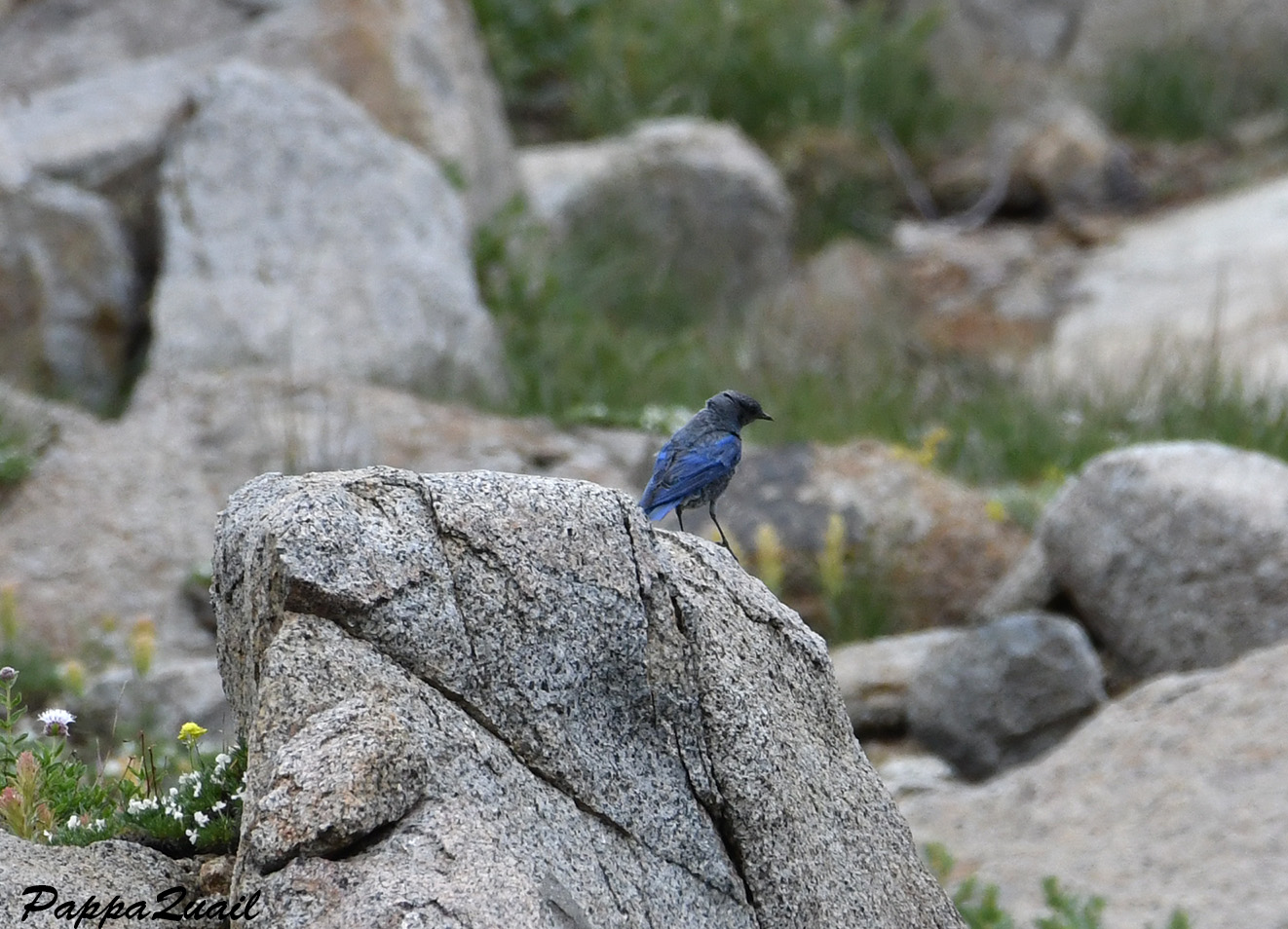
I was able to catch up promptly with the rest of my family because Pappa Quail and the elder chika were watching a group of mountain bluebirds. The birds kept teasing them - popping in and out of view and maintaining a constant, almost too far, distance.
Mountain Bluebird
Almost down by the lake the chikas found a suitable place for lunch break. Hidden in a nook between boulders and pine trees we found a relatively protected are where I could operate my backpacking stove and cook the offspring hot lunch, while everyone else settled for sandwiches or other dry snacks. And we all enjoyed a good, long break that at that time was well needed.
Winnemucca Lake
After a good long rest stop we got up and continued downhill to Winnemcca Lake. A large group of hikers came from above us and passed us, marching past the lake without stopping. We took it slowly, enjoying the sights. I stepped off trail to sink my hand in the snow. The snow looked pretty white from afar, but u close it was pink with algae growth.
Old Snow
The snow melt water drenched the trail, rendering it muddy for a good long segment. Not too far from the receding snow line the muddy ground was covered with a green mat of something that looked awfully familiar to me but I couldn't quite place it. At home I found that this was snow willow. In my mind a willow is a tree or a bush, but snow willow is a spreading, very low plant, well adapted to the alpine conditions.
While sifting through these photos I realized that this was the plant I had photographed in a tiny melted are of the snow covered mcCabe Pass just a week before, in Yosemite. That one was at a much earlier stage of budding but it was still astonishing how quickly this plant goes into boom once the snow cover is removed. Now willow indeed!
Snow Willow, Salix nivalis
Another wildflower that I've seen in big numbers in Yosemite's High Sierra on the week prior was the Leichtlin's mariposa lily. I have taken many photos of it there but that didn't stop me from taking many more photos of it on this trail as well. I always love to see mariposa lilies.
Leichtsinn Mariposa Lily, Calochortus leichtlinii 
We were walking eastward, descending to Winnemucca Lake. I looked over to the north into the gulch where we would later walk through on our way back to Woods Lake. It looked green and lush, and shaded. From this far I couldn't see what was waiting for us there. I was therefore, completely surprised when I did.
Red Lake Peak
Hints of what was ahead were already everywhere. Down near the lake where most of the snow had long melted away the shrubs were racing to peak bloom and the annuals following them closely.
Ciliate lungwort, Mertensia ciliata (the hanging-down flowers), together with Big Red paintbrush (Castilleja miniature) and Broadleaf Lupine (Lupinus latifolius). 
All of us, even the avid birders in our company, were audibly excited about the splendor all around. Looking at each plant, taking many photos in many compositions and different angles, and forgetting the chilly wind that kept whipping at us.
California Cornlily, Veratrum californicum var. californicum, together with Broadleaf Lupine, Lupinus latifolius.  
Not all of the colors were of floral origin., and not only plants were rushing to get their next generation going in the short alpine summer. The leaf of the creek willows had many of these red galls where little midges lay their eggs and their larvae grow protected from predators.
Willow gall
But the flowers! Oh, the flowers! And this was just the review!
Nature's Bouquet: Paintbrush (red), Lupine (blue), Groundsel (yellow), and Cornlily (white). And 50 shades of green. 
We didn't stop at the lake. The ground was too muddy and the wind too strong. We took in the view, waved goodbye, and moved on, turning to the trail down into the northbound gulch.
Lake Winnemucca
Pappa Quail and I did walk briefly down to the lake shore. He was scouting the water for ducks and I admired the pretty rhododendrons that bloomed down there, like those I've seen in Yosemite earlier.
Western Labrador Tea, Rhododendron columbianum

The creek draining the lake (for which I didn't find the name) was swollen with snow melt water and we crossed it balanced on two logs that were conveniently placed across. We still had to walk in the mud for some distance before we were once again on dry earth. The soil there dries out really fast, leaving the plants there thirsty soon after the snow thaws. That adds to the speed in which the alpine plants need to complete their reproductive cycle. Alpine summers can be very short.

Turning the corner, the lake behind me, I looked down on the slope and gaped. It took me a long while to recover my speech, and when I did, I couldn't hold it back. The photos I must say, don't do any justice to what we've seen there.
A blooming slope uphill of the Winnemucca Lake Trail
The winter of 2018-2019 was good in California. The rains did start late, too late for the November wildfires, but once started, precipitation came down heavy throughout the state, officially ending the longest drought period in post Gold Rush California. The following spring vast areas in California responded in super bloom. Fields upon fields of wildflowers matted California's meadows and hills, and the poppy fields of Southern California were so bright they were visible from space.
And I missed all that.
Bound by a tight work and school schedule, I remained at home, drooling over super bloom photos streaming through my feed while everyone else (or so it seemed to me at the time) was out and about, glorifying in endless carpets of colors (mostly orange).  Not that I didn't get out at all - I did catch some very nice bloom in the Gold Country and some other places, but not the big boom bloom I desired.
And here I was, staring down a long slope just below Lake Winnemucca, and before me was the most glorious spread of wildflowers I have ever seen in the Sierra Nevada mountains. Unlike the poppy carpets of orange, this slope was artfully quilted with many blooming species of many colors and hues.
Lake Winnemucca Trail
The snow pack of the Sierra Nevada was thick, and lasted long into spring and early summer. It is possible that had it been a shorter winter we would have arrived just in time to see the end of this magnificent bloom. As it was, it wasn't even at its peak. I saw no fruit and many young buds were ready to burst open near the mature blossoms.

Sweet fragrance was in the air, and I inhaled deeply. Little by little, I returned from my ethereal reverie and started looking at individual wildflowers as well.
Here too, there were those flowers I've been seeing for the first time.
Narrow Tube Ipomopsis, Ipomopsis tenuituba

And also very familiar wildflowers, like the crimson columbine which Pappa Quail captured with the hummingbird that was his primary target.
Allen's Hummingbird, female on Crimson Columbine, Aquilegia formosa 
While many plant species were blooming on that slope, a large part of them (I'd carefully estimate more than a half) were of the genus Castilleja - paintbrush plants of at least two, possibly more, species.
Castilleja pilosa (the yellow) and Castilleja miniata (the red)
The passing clouds made it difficult to capture the intensity of these colors and I tried not to manipulate the photos much, leaving them as close as I could to the natural image I've seen.
Winnemucca Lake Trail 
I enjoyed the brief periods of time when the clouds moved away and the sun broke through, illuminating the slopes and warming us.
We moved slowly down the trail. Although walking downhill, none of us wanted to hurry back. I could see everyone grinning, embracing the magnificent sights into their souls.
A blooming slope uphill of the Winnemucca Lake Trail
Paintbrush, lupine, and monument plants made the majority of the colorful bloom, complemented by the silvery green of the Artemisia shrubs. But there were many other wildflowers blooming there, some small and visible only when standing right over them.
Monkeyflower, Erythranthe 
Then, just as I thought I've seen all there was to see on that slope I spotted the unmistakable she of an orchid. Although small and green, an orchid is nonetheless royalty.
Bog Orchid, Platanthera sparsiflora 
A few backpackers were making their way uphill and I looked at them longingly. As slow as we walked we made progress still, and soon we would be back in the woods and out of the open slope of many colors. Now I was looking up at the mountainside, already sorry to be leaving it behind me.  
A blooming slope uphill of the Winnemucca Lake Trail
The steep trail leveled just before dropping below the tree line. In perfect timing the sun came out again, allowing us a last illuminated view of the rich quilt of Nature.
I felt as if I was floating when I entered the forest, and no longer felt any self pity for missing the spring super bloom. I finally caught up with it, in August, at this amazing trail of the High Sierra.
Lake Winnemucca Trail
One inside the forest our pace got much quicker. We felt as if everything that was worth seeing was behind us.
Lake Winnemucca Trail
That was not true, of course. The forest was very pretty too and the forest floor, although not like the carpets of the higher slope, also displayed a very nice bloom.
Cinquefoil, Drymocallis sp. 
But the best part of being back in the woods was that once again we were protected from the wind. It was getting late in the afternoon though, and still pretty cold.
It was my friend who found the tiger lily near the flowing creek and waited for me to show me. A very nice find it was, because the lies there were also before their peak bloom and had perfect flowers with intense color still.
Sierra Tiger Lily, Lilium parvum 

It was easy to miss the onion though, but I have been looking for it and very happy to find it. It's a low plant and although colorful, it blends all too well in the background of the forest floor.
Dusky Onion, Allium campanulatum 
The trail ended all too soon for me. We arrived at the creek crossing right by the Woods Lake campground. My family stormed on across the bridge, the chikas eager to get back to the car and everyone else ready to call it a day. I lingered behind briefly, breathing in the forest one last time before heading across the bridge.
What a hike that was!

At home I found that Pappa Quail didn't rush all the way to the car without stopping. He came across a squirrel, one of several we saw that day.
Golden-mantled Squirrel
Back in the car my friend became pensive and quiet. When I prodded she said that we had more than a week long trip ahead of us, but she cannot imagine any hike to top this one. I nodded. This hike was certainly one of the best I've had, one that more than compensated me for missing out on this year's big spring super bloom. 


Many thanks to Dean Wm Taylor and other members of the California Native Plants Society for their great help in identifying plants!