Date: March 31, 2018
Place: Jack London State Historic Park, Glen Allen, California
Address: 2400 London Ranch Rd. Glen Allen, Ca, 95442
Length: 5 miles
Level: Moderate
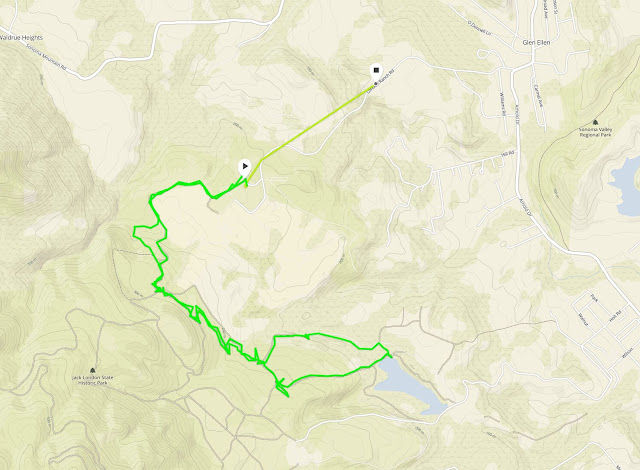 |
| Our hike as captured by Pappa Quail's GPS |
In my youth I read an entrancing book about a Californian dog that was kidnapped to serve as a sleigh dog for gold rush miners in Alaska, where he eventually turns wild and joins the wolves. Although I read other books by its author, Call of the Wild remains until today my favorite book by Jack London.
When I moved to California it didn't take me long to find out that Jack London's origin was in the Bay Area. He grew up in Oakland but had left his mark in many places around the Bay before becoming a world traveler and renowned reporter and novelist. In one of my earlier visits to Sonoma County I also discovered that he had a ranch there where he lived with his wife the last 5 years of his life, where now is the Jack London State Historic Park.
On that first visit there with my family I saw the historic buildings and ruins, and visited Jack London's grave. We couldn't stay long that time, though, and I left with a feeling that I didn't see as much as I'd liked to have seen of this park. It took me nearly 12 years to return there.
 |
| At the trailhead |
After a couple of previous plans for our spring break got cancelled I had to come up with a quick plan for the week long school break. I took the chance to plan a long trip to the Klamath area and then realized that the Jack London SHP was on the way.
We left home late on Saturday morning and I set the navigator to Jack London Park. When we arrived there it was already afternoon and we started down the trail thinking of having a nice, short hike before moving on to Arcata, where I have booked us lodging for that night.
 |
| Blue-eyed Grass, Sisyrinchium bellum, near the trailhead. |
It was a beautiful day, sunny and warm. We walked slowly, enjoying the country views of farmland and vineyards, looking for wildflowers, of which there were plenty, and absorbing the sun warmth.
 |
Sky Lupine, Lupinus nanus
|
A fence lizard watched us from its post.
Old farm buildings are scattered around the historic mansion. A tubular tower was visible from the trail that surrounds the vineyard. There was a trail leading there with a sign saying 'Pig Palace'. I was curious to see what's there but the rest of may family were already ahead on the main trail so the Pig Palace was left to the net visit (which I hope will be sooner than 12 years).
 |
| Pig Palace |
The vineyard is privately owned and the park's grounds surround it. The Vineyard Trail on which we hiked is a wide and easy dirt road, shared by hikers, bikers, and horseback riders. As we walked a pack of mules passed us and stopped to chat and allow the chikas to pet the animals. The guide suggested a vista point to the valley and I followed his advice. The view, framed by a large overhanging branch of a venerable oak tree was indeed beautiful.
Trees generally are at their best in spring time, especially the deciduous tree when coming out of hibernation in a new coat of young leaves.
The evergreen trees are not behind at all - already in bloom, the Pacific Madrone.
 |
| Pacific Madrone, Arbutus menziesii |
We took the hikers only trail through the woods up to London Lake. The lake turned out to be a small pond-like reservoir covered in duckweed, its shores overgrown with willows and dry-looking cattail.
 |
| London lake |
We explored the pond area a little bit. There were some wildflowers there, including many non-California native.
 |
| Purple Dead Nettle, Lamium purpureum. Non-native. |
And not always was the flower the colorful part.
|
|
Geranium purpureum. Non-native, invasive.
|
Under the nearby trees bloomed a few lupine shrubs. I almost missed them because they blended so well in the shade pattern of the forest canopy.
 |
Lupine, Lupinus sp.
|
I found there another lizard, and this one posed for me. This posture airs the lizard's belly.
If I'd have checked how long would be the drive to Arcata after we would have turned around at that place. Is it was, I guessed 2 hours and so we continued on to Fern Lake.
The trail took us through the woods, which were a mix of conifers and broadleaf trees. Most of the way the forest felt deep and dense with a wild feel to it.
 |
New growth of a young fir
|
In the forest depths - the regular undergrowth plants I was familiar with from the Bay Area, many of them in bloom.
 |
| Starry False Lily of the Valley, Maianthemum stellatum |
The chikas called my attention to a red flower a bit off the trail and I got very excited - the canyon larkspur adds much color to the relative gloom of the forest undergrowth and certainly stands out among the delicate white flowers that make most of them.
 |
| Canyon Larkspur, Delphinium nudicaule |
We crossed a small creek. The day was growing warmer rather than cooler so I had to urge my chikas away from there, as apparently this creek is a water source for the nearby homestead.
 |
| North Asbury Creek |
On the other side of the creek the chikas found a banana slug. Not a bright yellow one like those I see near Sanat Cruz but still a nice find.
 |
| Banana Slug |
Did I mention above that most forest undergrowth flowers are small and white? Well, some species compensate for that with numbers.
 |
| California Man-root, Marah fabacea |
Other show promise of sweetness to come :-)
 |
| Blackberry, Rubus sp. |
Some of theses forest whites were not small at all. I am always thrilled to see iris flowers. They look so majestic!
 |
| Fernald's Iris, Iris fernaldii |
And then, there was the unexpected late bloomer trillium. All of its friends had gone to seeds but this one was waiting for me to make e happy.
 |
| Western Wakerobin, Trillium ovatum |
We arrived at the trail intersection just before the lake. There was a small picnic area there and we sat down for a snack break. Other than the trail leading to the lake there was anther, narrower trail named Ancient Tree leading into the forest. I didn't think to go down that trail but a group of hikers that came from it urged us to go and see the tree. We did and I was glad of it - the Ancient Tree is an old redwood of the branching type, the only one left unlogged on these grounds.
 |
| The Ancient Tree |
We came back from seeing the Ancient Tree and immediately went down the dirt road trail leading to the lake.
 |
| Fern Lake |
Fern Lake appeared on the map to be out of the park's grounds but there wasn't any off limits sign. It was a much larger reservoir and the water seemed cleaner but there was no apparent access to the water. The lake was belted by a thick ring of cattail, willow, and other trees. We admired the view for a few minutes then started looking for the other trail that I wanted to take back to the farmhouse area where we started our hike.
 |
| Mourning Shroud Butterfly |
There was some ambiguity about which trail we should take because there were several, trails bracing out at that point. Pappa Quail was ready to start back where we came from but eventually we decided on the right trail that would connect us back with the Vineyard Trail and started the mild ascend back.
 |
| Up the trail from Fern Lake. |
It didn't take long before our mellow trail turned into a steep uphill grade, at the end of which all my family collapsed on the ground, panting. It was also the time when Pappa Quail begun questioning my plan for the rest of the day. It was getting quite late in the afternoon and he suspected we'd arrive at Arcata no earlier than 9 pm. Not really knowing the travel time I evaded his questions and focused on easier topics, like the flowers on the trailside, which happened to be both white and tiny.
 |
| Bull Clover, Trifolium fucatum |
After a short rest we moved on and rejoined the Vineyard Trail. The sun was getting low and the forest darkened.
When we emerged from the trees the trail was completely shaded. The mountain range across the valley was nicely illuminated though. From our angle we could not see the scars of the huge fire that raged in that area only a few months before.
Far across the vineyard was a dead tree, standing still. A turkey vulture was rooting upon it and Pappa Quail photographed it. Then a second vulture swooped by and landed on that tree. Then a third. I asked Pappa Quail to photograph all three but he had already dropped his camera and was striding onward.
 |
| Turkey Vulture |
I joined Pappa Quail and the chikas on the trail - going back now in the same way we had gone before.
As we approached the old farm buildings I saw a pretty blooming tree that I had missed on the way out. It smelled very nice too. A decorative introduced species - hawthorn.
 |
| Hawthorn, Crataegus monogyne, non-native, invasive |
Closing our hike I moved closer to a fenced patch of Opuntia cacti - prickly pear. Apparently Jack London was fascinated with these plants (No wonder. So am I) and planted this patch. This desert species does very well in the wetter Sonoma area.
Just before we completed our hike I checked quickly the expected driving time to Arcata and gulped - the navigation app said four hours. And it was already 5 pm. And there would be a dinner stop. Oops.
Thankfully Pappa Quail didn't push the point too much. There was nothing to do about it anyway, since we had our lodging already reserved for the night. It was a lovely hike at Jack London SHP and since we didn't go into any of the historic buildings or visited his grave this time, I do plan to visit there again. Besides, there are more trails in this park, enough for a few more good hikes.
We arrived at Arcata that night just past 11 pm.