Tuesday, April 2, 2013

The Spring Colors of Joseph D. Grant County Park

Date: March 18, 2013
Place: Joseph D. Grant County Park, San Jose, California
Coordinates: 37.34268, -121.71602
Length: about 2.5 miles
Difficulty: easy to moderate


Map scanned from park brochure, trail labeled yellow.
 A day before my friend was to go back I took her hiking a trail in Joseph D Grant County Park. I was testing a loop trail on which I was planning to take the chikas 4H hiking project. Part of that trail I knew from my earlier visit there last September. This visit, however, I could barely recognize the place. Since last Fall it went through such transformation!

The view to the southwest from the Yerba Buena trail

We parked at Grant Lake and started walking east on the Yerba Buena trail. For about a mile the trail goes through open grassland along Mt. Hamilton Rd. The hills are all green now with grasses, nearly all of them invasive species from the Old World. The grass looks uniformly green from afar, but a closer look revealed a whole lot of spring ephemerals everywhere.  Once spotted, they cannot be missed, these patches of color on the green mat. Here are some of the flowers we've seen there, please click on the photos for a larger view:
Douglas's meadowfoam


Lupinus bicolor
Ranunculus californicus

Dodecantheon hendersonii

Cidalcea malviflora
Viola douglasii


Many of the oak trees there are deciduous and were just beginning to bud out their leaves. Here's a freshly-folliaged Buckeye tree nestled between the late-awakend oaks:


After about a mile we made a sharp turn into the loop trail that leads to McReary Lake. This trail enters a narrow creek that quickly deepens into a decent size gorge. It was in this creek that we met this lovely dow who stayed stayed for a long time and allowed us to photograph her from a close distance.


Although more shaded, there were still quite a few wildflowers by that part of the trail as well.
Cynoglossum grande
I like trees with personality. This fallen tree looks like it's crawling out of the creek.

An interesting bird that hopped in the trees caught my eye. I spent quite a lot of time trying to get a clear shot of it. It didn't yield easily, but with much patience I eventually managed to photograph it. I was very proud of myself - it is a bird I've never seen before: a Varied Thrush.
Varied thrush
Soon we arrived at McReary Lake. Last September it looked like a mucky little pond. This time it was nice and full, and attractive to many birds.
McReary lake
There were quite a few ducks, grebes and herons in that one little lake, but I liked the cormorants most.
Cormorants at McReary Lake
Birds aren't the only residents of this lake. On a log in the lake some turtles were basking in the sun. They were quick to dive in the water as we approached for a close-up.
A log in the lake: turtle perch. 
And not only on that log:
A turtle in the sun
We sat for some time near the lake and then crossed the dam and continued on the northern part of the McReary-Grant trail toGrant Lake. The poppies that were closed earlier that morning were now opened.
Eschscholzia californica
Tree trunks can be growth beds for other things, mostly moss and lichen. This time, however, it was grass.
A natural plant pot
Grant Lake was also full to the brim but had less birds that time than we've seen last September. None of the wader birds, anyway.
Grant Lake
At that point we were in some hurry to go pick up the chikas from school so we didn't linger there and walked back to the car. We stopped long enough to say goodbye to that cute Spotted Towhee by the trailhead.
Spotted Towhee


Saturday, March 30, 2013

Little Yosemite at Sunol: a local treat

Date: March 15, 2013
Place: Sunol Regional Wilderness, Sunol, California
Coordinates: 37.50773, -121.82875
Difficulty: Easy to moderate

My friend came all the way from overseas to witness the great desert bloom. The hike we started with at Mount Tamalpais State Park was a very promising start. Our big desert trip, of which I will write separate posts, although rewarding in many ways, was a bit disappointing in regard of blooming, since winter had arrived late to Southern California and with insufficient precipitation.
The bay area, on the other hand, provided my friend with more than enough compensation. Springtime here this year is truly sensational. So I once again jump ahead my posting timeline to share the final hikes we did in the Bay Area before she got on the plane. 
Choosing of Sunol Regional Wilderness was almost instinctive. This park is just about the top of my list when it comes to adventurous solo hiking in the East Bay. Some of my most memorable wildlife encounters happened there, as well as my first (and hopefully last) encounter with an aggressive cow who didn't like to share the trail.

The boldest evidence for spring we met even before we entered the park itself: on the turn to Geary Rd. there is a regular flock of Wild Turkey. I see them nearly every time I go there. This time, however, they were busy courting.
Here's one of the males, showing off what he's got. As a mamma quail, I find him really cute :-) 
Wild Turkey, male, in display. Isn't he a hunk?
The girls didn't seem very impressed though. Considering, though, that new turkey chicks hatch each spring, I assume that some of the puffed-up males do get their way with the females. 
Wild turkey, females.
We didn't go an any adventurous trail this time, just walked along the Alameda Creek on the wide and comfortable Ohlone Camp trail. The trailhead is at the farthest parking lot in the park, right next to the woodpeckers' tree. There always there, the Acorn woodpeckers. This time, however, they didn't pose to the camera so I had to upload another woodpecker from a different tree, further down the trail.
Acorn woodpecker

Early on the trail we saw many wildflowers. I liked this shooting star most :-) 
Dodecantheon hendersonii
Next to the pinks there were also purples:
Blue Dicks (Dichelostemma capitatum)
And blues too:
Lupine
There were also yellows and whites and everything surrounded by 50 shades of green, just as a good spring should be!

There were quite a few more hikers on that trail. Even though we could see many birds very very close. This hawk, for example, only hopped to the next tree over when we approached. It has a regular nest there on one of these trees. I've seen it populated a couple of years in a row.
Red-tailed hawk
After about a mile of walking we arrived the area called 'Little Yosemite'. The name might get some giggles from people who've been to The Yosemite, but seeing that park of the creek from up close it is clear why it is so named.
Some of the cascades of the Little Yosemite area. 
Other hikers that came down to the creek actually climbed the rocky cascades to explore further, but my friend and I were  happy just sitting on the rocks and enjoying the watery view. It was a great sight, particularly in comparison to the same time last year, when the Alameda Creek was reduced by the draught to a mere trickle.  
A water pool between the cascades.  
Beyond the Little Yosemite area the trail continues into the Ohlone Wilderness - an area that requires a wilderness permit. At that point we turned around and started back.
Fern on the rocky canyon walls
We encountered this little Dark-eyed Junco as we scrambled back from the creek to the main trail. It is a very common bird in the Bay Area.
Dark-eyed junco
A little less common, and much more exciting - a Golden Eagle glided above. A truly majestic bird.
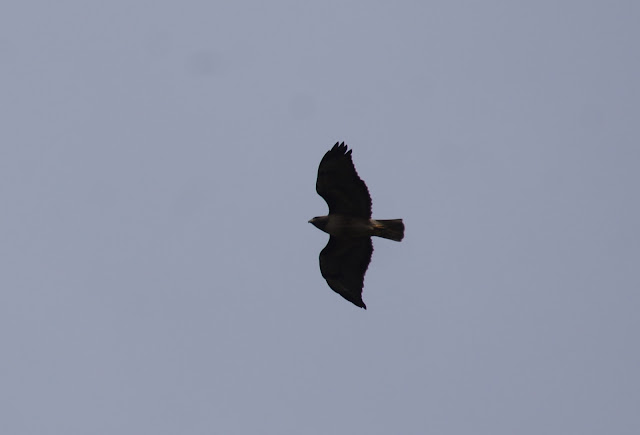
Golden Eagle
Spring time is flower time. Flower time is butterfly time!
Sara Orangetip (Anthocharis sara)
My friend specializes in photographing butterflies. After chasing the Orangetip myself for some time, trying to catch it in a restful second for a good shot, I could really appreciate her patience and skill.  The  Blue was easier to photograph. It is territorial, said my friend, and always comes back to the same spot.
Silvery Blue (Glaucopsyche lygdamus)
The Little Yosemite of Sunol is a beautiful trail, about 2 miles in and out, also passable by large-wheeled strollers. It is an excellent choice for a family outing any time of year, but this spring it is absolutely gorgeous!


Sunday, March 24, 2013

Life and Death at Salton Sea

Date: December 28, 2012
Place: Salton Sea, Bombay Beach, California
Difficulty: easy
Salton Sea, a view to the north from Sonny Bono Salton Sea NWR
The water of Salton Sea bring life to a large desert area, where it had supported and still supports rich plant and wildlife as well as human settlements throughout its existence period. At Sonny Bono Salton Sea NWR we enjoyed viewing many of the bird species that make this sea their home, throughout the year or just for the winter, or make it a rest stop on their migration.
After leaving SBSSNWR we continued north along the eastern shores of Salton Sea, and in the little town of Bombay Beach we stopped and went for a walk on the beach.
A salt crusted field lies between the town and the beach
Salton Sea is a periodical lake. It is fed by washes from the surrounding mountains, but its main body of water originates from flooding of the Colorado River. The Salton Basin was formed and dried numerous times throughout its geological history. The latest flooding and the creation of nowadays Salton Sea happened in 1905, with unintentional human mediation, when an irrigation canal that diverted the water of Colorado River to irrigate fields was breached. This flooding was a major prompt for the Colorado River damming.
Someone went shopping for salt?
Being a basin with no outlet, the salts remain in Salton Sea and with the Colorado River under control, no more unexpected flooding are expected. Therefore, water level continuously drops and water salinity continuously increase. It still supports aquatic life so is not yet a dead sea, but it is going in that direction.
The white-crusted beach at Bombay Beach
There is no specific trail there. It was all about walking on the beach for however long we wanted. There were very few people there so we literally had the beach to ourselves.The chikas soon found an interesting play thing - some mummified fish stranded of the beach. There were plenty of them around. 
This was once a living Tilapia
The ground under our feet felt course and our footsteps made loud crunching sounds as we walked on the beach. It didn't feel or sound like a mere salt crust. At some point I knelt to check the ground more closely and discovered the disturbing truth: we were walking on a thick layer of fish bones.
A mat of bones
Not just in a small area. Everywhere!
Not the work of local fishers but evidence of a large-scale calamity that befell these fish.
That evening I searched online and found that the fish disaster had happened just a few month before. The mass death was attributed to the drop of oxygen levels in the water due to a prolonged heat wave in the area. The stench of the rotting fish, it said, was so strong that it could be smelled at Los Angeles.
A sea of dead
I was glad we had missed these odors. 
Not just dead fish: the mark of man.
We had stopped at Bombay Beach with the idea of looking for more birds but there weren't that many there. Just a few cormorants and gulls. The sun was already setting so we returned to our car and drove north to Palm Springs, for the third part of our winter vacation.
Seagulls at Salton Sea


Wednesday, March 20, 2013

Who's at Sonny Bono Salton Sea NWR?

Salton Sea, a view to the north from unit 2 of SBSSNWR
Date: December 28, 2012
Place: Sonny Bono Salton Sea National Wildlife Refuge, Calipatria, California
Coordinates, Unit 1:  33.0860, -115.7096   Unit 2: 33.1767, -115.6190
Difficulty: easy

In the middle of the Southern California desert there's a large body of water called the Salton Sea. It is a periodical lake of which I plan to write a separate post. Being a source of water and food in a vast desert area, it is also a big attraction to wildlife, primarily birds. Several areas along the Salton Sea shores were set aside as refuges, We visited to of these at its southern shores: Units 1 and 2 of the Sonny Bono Salton Sea National Wildlife Refuge.
Snow geese in the fields. Unit 1 of SBSSNWR.
Unit 1 has an observation tower and a short foot trail of about 1 mile. We spent some time observing the birds from the tower and conferring with other bird watches who came by.
The fields to our south were filled with Snow geese but the ponds were relatively empty, save for a few ducks.

The water ponds at unit 1.
We did see a few raptors hovering in the sky and quite a few warblers who were quick to hide when we tried to photograph them, Even the Great Blue Heron we saw trotted away quickly.
The foot prints of a Great Blue Heron
We walked the foot trail and listening to the bush birds among the high and dry tules and cattails. Then we returned to our car and drove on to Unit 2.
Ring-billed Gull, Unit 1 of SBSSNWR
Beside a 1.5 miles hiking trail and an observation deck, Unit 2 also has a nice visitor center with a landscaped yard. This yard alone is an attraction for many animals. For example, this barn owl that we saw sleeping, tucked in one of the fan palms, just outside the visitor center.

Sleeping Barn Owl
On the ground, many cottontails were hopping around, to the delight of my chikas.
Cottontail rabbit
The high-pitched squeaks and the low-pitched buzzing of hummingbirds was in the air.
Anna's Hummingbird, female
And a species of dove we've never seen before. Those tiny little doves were very shy and kept to the bushes. Eventually, Papa Quail's patience and high zoom lens paid off:
Common Ground Dove
But I think that our nicest encounter was with my close relatives, the gorgeous Gambel's Quail :-) 
Gambel's Quail
Eventually we managed to collect the chikas from their activities and went on the trail. It is a very nice in and out trail along a canal and later along the Salton Sea shore itself. It is completely flat, except at the end where it climbs a small hill. From this trail we had a fantastic view to the northwest, where we could see the snowy caps of Mount San Jacinto (left) and Mount San Bernardino (right).

The canal and the bushes along it harbored several bird species. This Lesser Yellowlegs was one of them:
Lesser Yellowlegs


When we got to the Salton Sea shore we saw it was quite popular among seagulls. There were quite a few other birds there, from various ducks to some waders, and four or five large Great Blue Herons that stood still in the water, keeping respectful distance from one-another.
Gulls and friends
When we approached the shore the water appeared rusty red, as if soiled by a river of blood. I don't know what caused the coloration - probably just the ground underneath, I guess. Nevertheless, it was a strange sight. 
No Pharaoh here, no real blood.
From what we read about the place we learned that even deep ocean birds occasionally make it to Salton Sea. We didn't see anything unexpected. Here are some of the birds we did see:
Ring-billed gull
Black-necked Stilt
Western Sandpiper (adult, non-breeding)
We had a great time at Sonny Bono Salton Sea National Wildlife Refuge. We hiked the trails and saw many birds. For any nature lover who travels in the area, this is certainly a good place to stop. Personally, I believe it is worth a special trip :-) 
Salton Sea, shining in the sun