Showing posts with label Santa Cruz County. Show all posts

Monday, August 22, 2022

Hugging the Coastline: A Discovery Hike at Wilder Ranch State Park


Date: October 16, 2020 and November 1, 2020
Place: Wilder Ranch State Park
Coordinates: 36.960410, -122.085699
Length: 3.2 miles
Level: easy
 
In the fall of 2020 it looked like things were slowly opening up again after long months of closures and social distancing, and I thought it would be a good time to restart my family hiking groups again. Half sized groups, masks, and the great outdoors. Wilder Ranch State Park near Santa Cruz has been on my list for a while now and I thought it would be a good place to resume the group hikes at. First of course, I needed to go and scout the trail on my own, and I did that on a nice and sunny October day.
My hike as captured by my GPS
 
I started by going east on the ranch road that leads to an underpass under hwy 1. I wanted to see how the uphill trail looked like, and it didn't look good at all - the CZU fire of that summer had reached the western slopes of the Santa Cruz Mountains and the entire hillside looked very sad in the fire's aftermath. My little stroll there however, brought me near the historic ranch complex. The museum was closed because of COVID but the complex looked really nice. I marked the shaded lawn in my mind as a possible picnic spot for after the hike.
Wilder Ranch
 
 From the ranch complex I turned south toward the coastline. I didn't expect to see any wildflowers so late in the fall, and I was happily surprised to see a few poppies blooming by the trail.
California Poppy, Eschscholzia californica
 
 The trail crossed a railroad. It was clear that this railroad has not been in use for quite a long time.
 
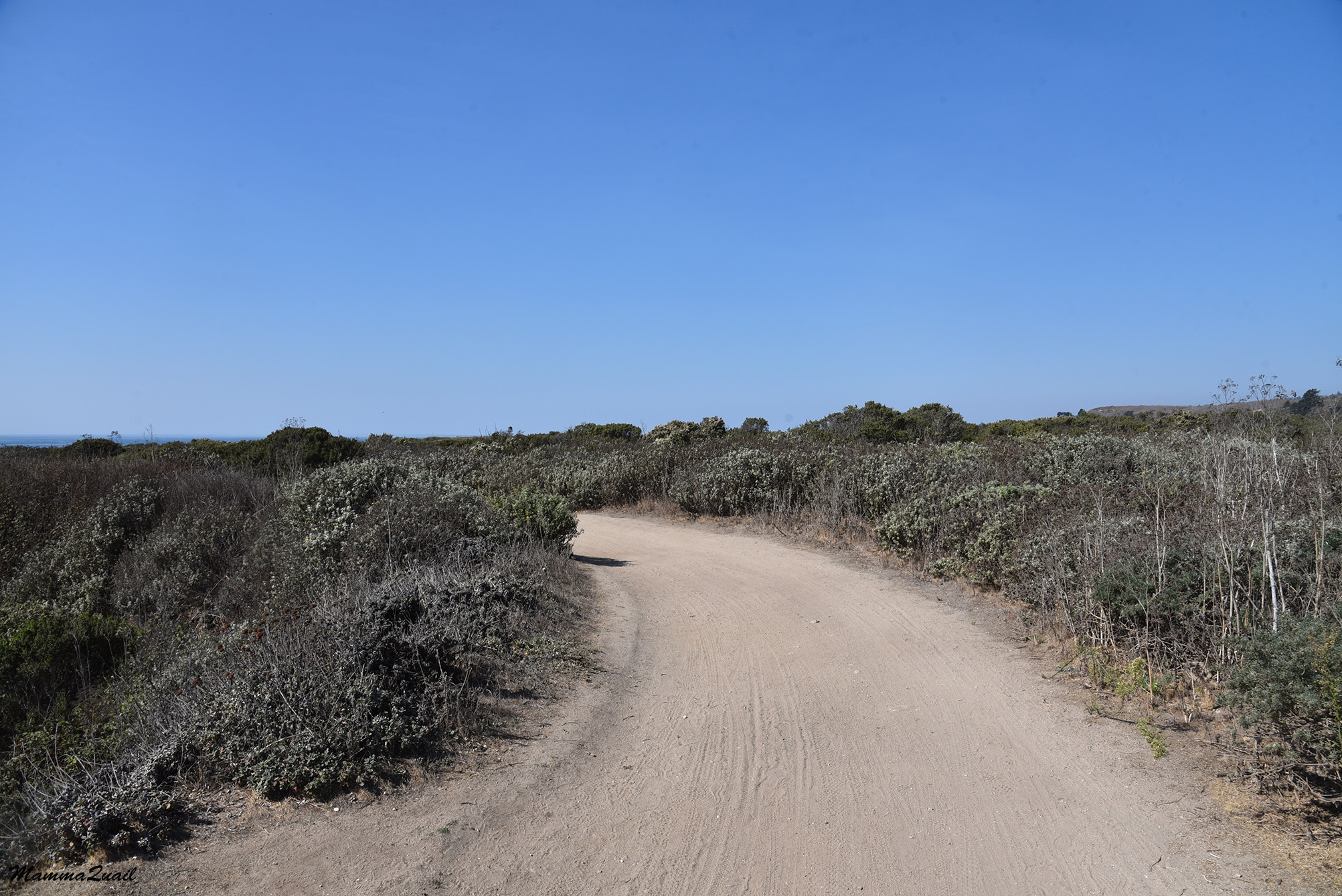
I crossed the railroad and continued south on the dusty trail. The day was bright and warm, and a light breeze blew at my face.
 
 Little sparrows flew here and there in small groups, chirping all around me. A small covey of quails crossed the path and disappeared into the bushes on the side before I had the chance to raise my camera. One of them, a female, lingered long enough in the bush near the trail.
California Quail, female
 
I reached the coastline and I was high above the water. Below to my left was the eastern beach and signs were posted forbidding going down to that beach. It was a protected area for wildlife only. A large brown thing on the sand turned out to be a dead seal. its remains were still there two weeks after when I came there with the family hiking group. On that visit we also got to see nature's sanitation squad in actin - four turkey vultures working hard on that huge carcass. 
 
After reaching the ocean the trail followed the contour of the coastal cliffs, staying well above the sea. The coastal cliffs at Wilder Ranch are not as high as in other places along hwy 1 but they are no less beautiful. There was something very captivating about the gentle walk right above some very rough water. I loved seeing the waves crash into the cliffs, carving them with depressions, coves and caves.
 
To my right was the flat plateau that stretched all the way to the highway. Outside of the park's boundaries there were vegetable fields on that plateau. Inside the park where the land wasn't irrigated, most plants were dry except for a few perennial or biennial species that either remained green from last season or has sprouted new growth in expectation of winter rains.
Yellow Yarrow, Eriophyllum confertiflorum
 
I was pleased to see some more bloom along the coastline. These plants benefit from the cooler temperatures and the frequent fog. They are also more tolerant of the salty breeze that batter them regularly.
Pacific Aster, Symphyotrichum chilense

I finally managed to photograph one of those hyperactive sparrows. Perhaps it was less evasive because it was a young bird. 
White-crowned Sparrow, Juvenile
 
About half a mile down the coastal trail I reached a large flat cliff area with an excellent view of the coves to west of where I was. It was an excellent spot to sit for a snack break and some peaceful musing about life.
 
Two weeks later I stopped with my family hiking group at that very spot for a picnic lunch. That day was very windy and the time was high tide time. What impressed me most though, was the large number of birds, mostly gulls and pelicans, that floated on the water inside the cove. They didn't seem to be feeding, I suppose they too liked this place as a resting spot. 
 
I resumed my walk along the coastal cliffs, still paying attention to the wildflowers that bloomed beside the trail. 
Seaside Daisy, Erigeron glaucus
 
There were more flowers than I had expected to see but nearly all of them were of the aster family. When seeing wildflowers bloom outside the peak season, it is a sure thing that the aster family will be represented , and is well represented among them.
Yarrow, Achillea millefolium
 
 I did find one blooming plant species that was not an aster however. It was the coast buckwheat, of the Polygon family, which is also a very large family with many hardy species.
Coast Buckwheat, Eriogonum latifolium
  
Small groups of brown pelicans scouted the coastline, gliding low above the water. Some times I see them dive for a fish but not on the day of my hike.
Pacific Brown Pelican
 
I came to a cove that was much deeper than the others, which meant I that I would have to turn back inland in order to bypass it and get to the other side. 
 
As I started my bypass of this 'fjord' and as I was making my way around the cliff I looked down and saw rocky shelves and islands well below the cliffs but above the water. Many cormorants were roosting on their rocky shelves.
 
Two weeks later there were even more cormorants there, covering the low rock islands, perfectly located just outside the pecking range of its neighbors.  
 
The other side of that cove also had low rock platform extensions. These were occupied by sleeping seals.
 
I had a better view of the seals after I reached the spot right above their sleep shelf. I stood there for some time, watching them sleep peacefully, mostly motionless except for an occasional stir.
Harbor Seals
 
 I moved on from there and continued west along the path. That area of the park had much fewer people in it, and for the most part I was alone. I did have to watch out for bikers though. I saw a few of them on this hike, and some were coming down the trail pretty fast.  
 
I came upon another cove, narrower and deeper. The strand line looked thick and muddy but this brown stuff wasn't mud - it was rotting kelp. I'm glad that the photo doesn't convey the thick aroma of this fall time rot.
 
There was a way to get down there but I decided not to.  On the family group hike two weeks later we did go down that cove - we were hoping to have some respite from the gale winds we had that day. the narrow cove did provide some protection but the smell was too intense to truly enjoy the setting.
 
Eventually I reached a point of decision - should I continue west along the coastal trail or should I take the trail leading back to the ranch complex? I decided to walk west a bit more, and then I turned and looked at the beautiful coastline that stretched behind me, to the east. It was so beautiful, I wanted to stay there much longer. I did need to go back however, and so I turned around and when I reached the trail junction again I took the turn to the park's headquarters. 
 
The return trail had some interesting surprises too. It stretched along the park's boundary and on the other side were vegetable fields. Some of the fields had Brussels sprouts, which are very interesting plants to see. The most interesting though, were the fields of artichoke. This cultivated thistle grows to an enormous size and has a really beautiful bloom. Since the edible part of the artichoke is the inflorescence bud, they are harvested before they have the chance to open. The field I was walking along was already harvested but a few artichoke buds were missed and they were now blooming. I trespassed into the field to take a close up photo of one of these gorgeous blooms.
Artichoke
 
The weather was nice on my solo prep hike but on the group hike the wind was really brutal. Still we enjoyed the hike in this beautiful setting. It seemed as if things were getting back to normal again. Shortly after however, everything closed up again. Many parks in California were closed once more and I had to suspend the group hikes once more. I slipped into a very sour state, a condition I got out of after isolating myself in the desert for a few days, just me alone at the Coso Range. I haven't been back to Wilder Ranch since this hike, and I nearly forgotten that it happened. When a friend who'd been in the family hike had reminded me of that place I dug up the photos and wrote this post. Now I'm looking forward to go there again and continue exploring this pretty park.


Friday, September 24, 2021

Deep In the Forest of Santa Cruz Mountains: Hiking at Loch Lomond (not the original one)


Western Wakerobin, Trillium ovatum


Date: April 24, 2021
Place: Loch Lomond Recreational Area 
Coordinates: 37.111114, -122.064768
Length: 5.1 miles
Level: moderate


Last April it was becoming clear that our school district wasn't going to resume in-person learning that year. Frustrated and stresses I kept looking for outdoors relief and looking for new paces to hike at around the Bay Area. 
Loch Lomond is a lake in Scotland. North of Santa Cruz there's a town called Scotts Valley and near it a smaller town named Ben Lomond. There's a large reservoir there called Loch Lomond. Every time I go to Henry Cowell Redwoods State Park I pass through Scotts Valley and pass the signs directing to Loch Lomond. Every time I tell myself that one day I'll go and check it out. One day I told my family that the time had arrived, and we're going to hike at Loch Lomond. 
Driving there is quite and experience. After reaching Felton and deviating from the road I usually take to reach Henry Cowell Redwoods park, the road to Loch Lomond is actually very narrow and scary at places. That people actually live along this road makes it all the more adventurous. 
 
Our hike at Lock Lomond Recreation Area as captured by my GPS

Loch Lomond belongs to the Santa Cruz Water District and the recreation area is quite popular. When we arrived there the lower parking lot was already full so we parked at a higher one and then walked down to the boat launch where the trailhead was. We avoided the numerous people that were sitting by the water there and immediately started north along the lakeshore trail. 

The trail was somewhat elevated from the water line. More like, the reservoir was already draining. A few lazy geese floated on the surface, but other than they, the lake was fairly empty of waterfowl. 
Loch Lomond

The wildflowers display near the trailhead was also a bit dull. After a short distance however, I did get to see, and mainly to smell, the lovely ceanothus. 
Jim Brush, Ceanothus oliganthus

Further down the trail it started looking more like spring, with many more wildflowers, most of which were little undergrowth flowers. 
Pacific Starflower, Lysimachia latifolia

The first segment of the trail, the part that follows the lake shore, was easy enough, with hardly any elevation changes. We walked briskly down the narrow path, occasionally passing other hikers. There weren't that many hikers there - I guess most of the visitors were there to enjoy the water rather than the land. 
Trail

The first iris was a surprise. Pappa Quail and the chikas saw it first and called me to hurry up (not that the pant would have gone anywhere had I taken my time). It was indeed very exciting to see it. Later I would see many more irises along the lower part of the trail, yet my excitement would not diminish one bit. 
Fernald's Iris, Iris fernaldii

The forest undergrowth was fairly thin. Mot much light filters through a redwood forest canopy. The bushes that I did see growing there were too in bloom. Among these was the huckleberry, sporting clusters of delicate flowers, similar to those of its relative, the manzanita. 
Evergreen Huckleberry, Vaccinium ovatum

The chikas yelled to me again even more excited than before. When I arrived where thery were I saw that they found a trillium in bloom. I was surprised to see it because it was already pretty late in the season for trillium. I though this might have been a straggling individual but sure enough, there were many more of them blooming along the lakeshore part of the trail. 
Western Wakerobin, Trillium ovatum

An opening in the trees gave us an open view if the reservoir. I was dismayed to see how low the water level was. The past winter had been just about nonexistent and this was a sad foreshadowing of the long, dry months ahead. 
Loch Lomond

Awe found a small picnic area and sat down for a lunch break. As always, I was giving much attention to the wildflowers nearby. Pappa Quail and the elder chika scanned the lake's surface for any waterfowl but all they saw were a couple of canada geese. It didn't take long for Pappa Quail to start referring to the hike as "mom's hike" because we saw many wildflowers but hardly any birds. 
Common Pacific Pea, Lathyrus vestitus

There were some mushrooms too, but not the kinds that pop right after the rains. Turkeytail mushrooms are colorful and pretty, though. 
Turkeytail

Beyond the picnic area the trail curved uphill and we followed it on the steep incline. At a slower pace I could enjoy the wildflowers while keeping up with the rest of my family. 
Feathery False Lily of the Valley, Maianthemum racemosum

The display of wildflowers was different further away from the lake and deeper in the woods. Seeing so many strawberry flowers I almost wished it was summer already.
Wild Strawberry, Fragaria chiloensis

There were many, many spider webs all over the place. One could think the forest was preparing for Halloween, or something. I love these little web-spinners. Especially the dome-spiders. Their webs look so elaborate, it's amost hard to believe that this design is engraved in their genetics. 

The trail continued up and up, and we ascended steadily and a moderate grade. The trees changed from redwood to fir, with an occasional oak in between. 

I'm used by now to seeing galls on oak trees, but this type of gall I don't see all that often. It looked like it was a nursery for many individuals, I don't know of what species. 
Gall

Occasionally the forest canopy would separate a bit to let more sunshine down to the forest floor. In these sporadic sun spots there were the chaparral flora representatives, such as the sticky monkeyflower. 
Sticky Monkeyflower, Diplacus aurantiacus

There were also more irises along the trail, and my camera card was filling with numerous photos of these beautiful flowers. I posted one earlier but this iris was showing a different ornament - the empty skin of a cicada nymph after its final molting. 
Cicada Molt

The darker areas of the forest's undergrowth were dotted with lovely, delicate violet flowers. Always a favorite of mine, especially the non-yellow ones.
Western heart's Ease, Viola ocellata

Wood rose bushes were blooming as well, adorned with few, bright pink blossoms, not too many but enough to make a memorable impression. And I wasn't the only one impressed - many pollinators were buzzing in and between the rose flowers.
Wood Rose, Rosa gymnocarpa

When we reached the ridge we found out that we were not done with the uphill at all. The ridge trail was undulating up and down at even steeper grades than the trail we ascended on from the lake level.


Shortly after making the turn onto the ridge trail we arrived at a high point with an open view. There was and old picnic table there, and we soon discovered that we needed to be very careful when sitting on the rotting benches. The view form that place was very lovely indeed. We could even see the lake way down below.
Lake View

Under the full sun the vegetation was mostly chaparral, among which the most dominant was the yerba santa, at peak bloom.
Yerba Santa, Eriodictyon californicum

Beneath the larger chaparral bushes I spotted the red woolly paintbrush plants, now called Texas paintbrush. 
We stayed at that view point long enough to rest and appreciate the view and the wildflowers, but seeing no birds, the rest of my family were soon itching to go on.
Texas Paintbrush, Castilleja foliolosa

We continued on the ridge trail in what felt to us as mostly uphill but in fact we were slowly descending towards the access road. Most of the ridge trail was well shaded. At time it seemed as if we were walking through an enchanted forest from some fantasy book.

As we neared the access road and the closing of our loop hike, the trail entered a grove of redwoods. Had we've been hiking there 200 years ago we would have see all the giants intact. As we were, we saw large sad stumps of what once a proud giant redwood grove. Rings of young redwoods, clones of the logged giant in the middle circled each stump. The ancient forest was renewing.
Coast Redwood, Sequoia sempervirens

When we arrived at the access road, all that was left to walk was about half a mile down the road. Surprisingly, there was no trail parallel to the road so we had to walk on the asphalt and dart to the side each time a car came past us.

Crimson Columbine, Aquilegia formosa


At the top parking lot I left the rest of my family and made a quick dash down the road to fetch the car. I was happy about the hike, glad to have finally made it to that mysterious green spot on the map that had lured me for so long. A nice place.