Showing posts with label peninsula. Show all posts

Tuesday, November 26, 2024

Late Summer Redwoods: Hiking at Sam McDonald County Park


Date: August 20, 2024
Place: Sam McDonald County Park, La Honda, California
Coordinates: 37.296606, -122.265540
Length: 6.1 miles
Level: moderate


It is normal for me to hike at a slow pace, unless of course, I am in a hurry. In the last year however, my slow pace resulted also from advanced arthritis in my left hip which caused me great inconvenience and considerable pain. The situation deteriorated to the point that nothing else worked anymore and I scheduled a hip replacement surgery for the end of August. Knowing I'd have a long period of home rest without any hiking I was eager to get one more trail hiked before the surgery. So three days before I was planned to get under the knife I connected with my friend and we met at Sam McDonald County Park for a hike in the redwoods. 
The first thing I saw when I stepped out of the car was a single banana slug that was half hidden under the log marking the edge of the parking area. 
Banana Slug

The visitor center cabin was closed. My friend an I paid the parking fee using the little envelopes they had there, grabbed our packs and started down the path that led to the trail of our choice. 
Our hike as captured by my GPS

 A short path connects the parking lot to the road accessing the park. The trailhead we sought was on the other side of that road. Right by the connecting path grew an old redwood tree that had a through huge fire cavity that ran along most of its trunk length. I just had to look through it. 

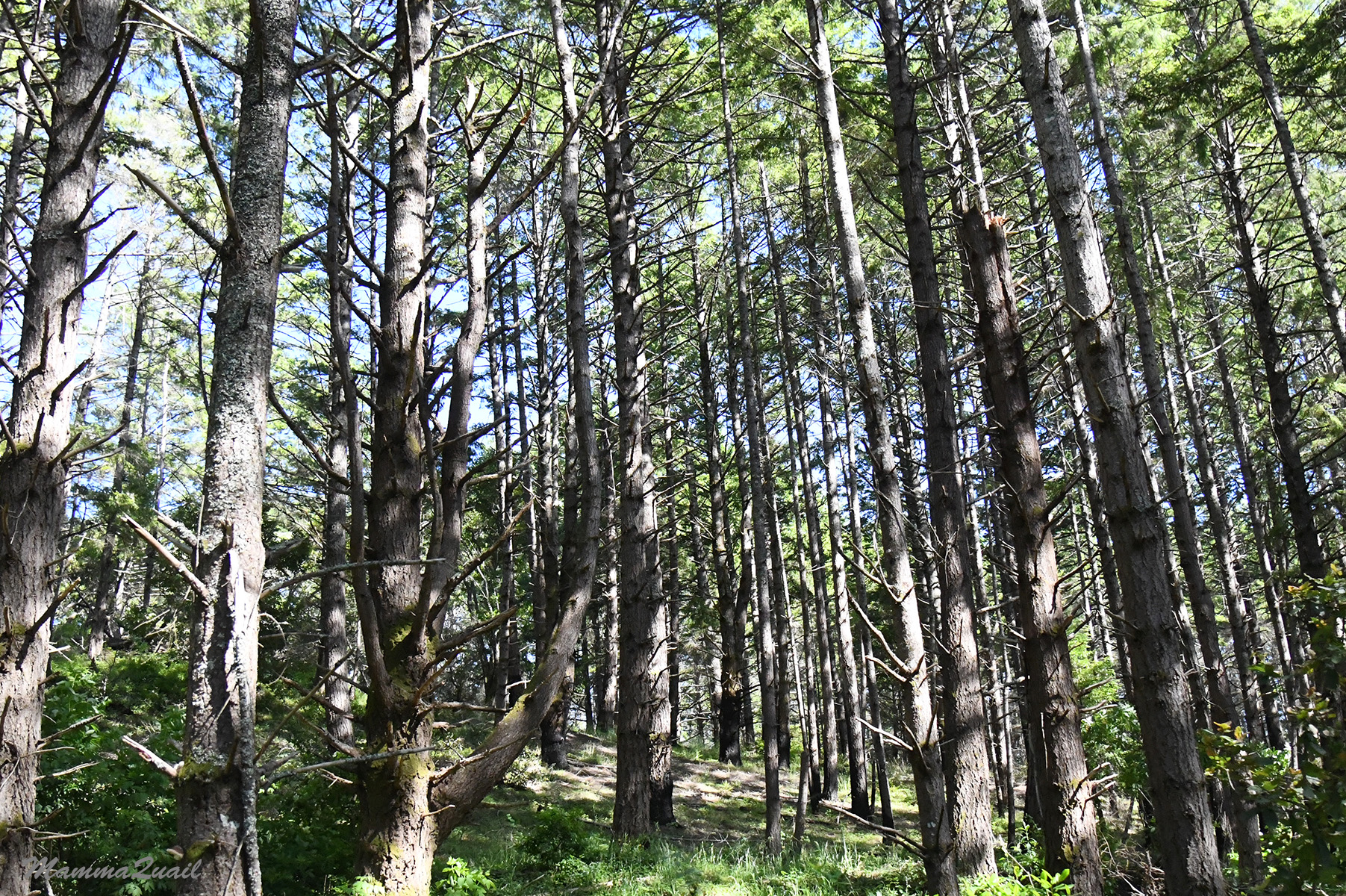
The trail we started on was the Towne Fire Road which, as it was named, was a wide dirt road. It was convenient to walk on, but its slope was pretty steep at times. We started hiking uphill right from the trailhead, going at the slow pace that my condition allowed and enjoying a friendly chat and the grand view of the redwood trees.
Towne Fire Road

It didn't take very long before I stopped short and stepped off the trail - I saw an orchid in bloom! I already knew this orchid species - it was not a California native but an introduced species. Still, an orchid is an orchid. Naturally, I spent some time taking its photos from every direction. I later saw many more of these orchids on this hike and my excitement subsided a bit, but I still took more photos. 
Broad-leaved Helleborine, Epipactis helleborine, non-native

Other things that thrill me are pretty spider webs. I see these utilitarian webbings as nature's works of art. In this case, the artist was sitting right in the middle of its creation.  

We saw many spider webs on that hike, most of them of the dome web type, but this one was different - it weaved a tunnel, a hiding place for itself, at the top of its web. 

We came upon a side loop trail named, "Big Tree" and we turned onto it, hoping to see an old growth redwood there. 
Big Tree Loop Trail

There might have been an old growth redwood there indeed but my friend and I were in the midst of a heated debate so it is likely we simple stormed by the tree without noticing it at all. When We came back to Towne Fire Road a bit further up I remembered about the redwoods, and although I didn't turn back, I did photograph the high canopies of the nearby trees. 
Coast Redwood, Sequoia sempervirens

Once again on the wide dirt road that was Towne Fire Road Trail we continued uphill, but the slope was milder now, and even dipped a bit at times. By and by we started seeing other hikers as well. 
Towne Fire Road

A thick redwood forest doesn't let much sunshine through, so the forest undergrowth plants aevolved for high shade tolerance. I was glad seeing them down below the trees. Some of them were even blooming still. 
Foamflower, Tiarella trifoliata

Other forest floor plants were already in their fruit stage. There are a few species of False Lily of the Valley plants on the redwoods of San Mateo County, but based on the fruit and foliage alone I couldn't determine which species was the one that I saw there. 
False Lily of the Valley, Maianthemum sp. 

Towne Fire Road Trail had a lot of trail junctions leading to other side trails and zig-zag turns. At each such intersection we needed to make sure that we were on the right path, going in the right direction. 
Towne Fire Road

As we approached the next curve I saw a covey of quail up the trail and immediately pulled my friend to the side. I pointed them out to her, and commenced taking photos. I took many photos of that covey, as they run on the trail, and I'm embarrassed to admit that none of them turned out very good. I blame that on the distance of the birds, on of course on the forest's treacherous lighting. The quail were very cute and fun to watch, but eventually they vanished in the forest and we resumed our hike. 
California Quail

It didn't take long before we had our next wildlife excitement in the shape of a beautiful young buck that we spotted across the creek from us, walking at ease on that steep mountain slope. The buck noticed our presence and stopped, ;looking at us gravely for a long minute before moving on. 
Black-tailed Deer, buck

We were about to move on as well when we noticed another deer - a young doe that was following the buck. The doe paused in exactly the same place that the buck did, looking at us as well. Eventually she moved on too and my friend and I continued up the trail. 
Black-tailed Deer, doe

We reached the high part of the park. Towne Fire Road was going all the way to the junction with the Heritage Grove Trail which we planned to take back downhill, but when I saw that there was a hikers trail that paralleled the dirt road I pulled my friend to walk on that one instead. 
East Brook Trail

We didn't see many birds on this hike. We heard them - they were in the trees, but they didn't make themselves visible. I was happy therefore, too see a single towhee perched on a low redwood branch right by our trail. Looking closer I was less happy for the poor bird - he looked unhealthy. I hope that he made it through whatever that was. 
California Towhee

Up on this path we got our first sight of an open area - a true forest clearing with savanna like grassy area that was bathed in sunshine. 

Nearing the end of August, the grass was dry and yellow. There were some green plants here and there in the open field, and some of them where blooming still. 
Aster

For a short distance we merged wit the Towne Fire Road again. By then  the debate my friend and I had moved from politics to dentistry. I'm not sure why I remember this particular detail, it must have been painful enough. 
Towne Fire Road

The California coast is one of those regions where some wildflowers can always be seen, year round, even if very few. As the end of summer was drawing near and most plants have gone to seeds already, I was still finding some wildflowers at the driest part of the hike. 
Varried-leaved Collomia, Collomia heterophylla

Not all the wildflowers I saw were native species of California. I don't usually post photos of invasive species in my blog but sometimes their beauty overcomes my resistance. In the case of the thistle in the photo below, it was the lighting that gave it the glow. 

Shrubs and vines can afford themselves a longer bloom season than annual herbaceous plants. I was happy to see some honeysuckle also blooming by the trail. 
Pink Honeysuckle, Lonicera hispidula 

My friend was not as interested as me in all the local flora but she patiently put up with my enthusiasm and with me pointing out and naming out loud all the wildflowers we've seen along the hike. This has never stopped her from joining me on the trails. 
Spanish Lotus, Acmosipon americanus

For a brief distance the view opened up before us and we could look ahead onto the rolling slopes of the peninsula ridge mountains and a lovely endless-seeming conifer forest. 

Although the forest here was primarily of coast redwood, other conifer species were also quite prevalent. One of the more common trees in the surrounding forest was the Doulas fir which can grow almost as tall as the redwood. 
Douglas Fir, Pseudotsuga menziesii

We reached Heritage Grove Trail junction and start on the trail that would take us down the mountain. We wanted to take a break but didn't want to sit in the sun so we kept going on, hoping that a suitable location would present itself soon.
Heritage Grove Trail

The last dry clearing we crossed provided the nicest wildflower species I've seen on the hike - the California fuchsia. The bush had only a few flowers still open but it was lovely to see. 
California Fuchsia, Epilobium canum

Soon we reentered the forest and started walking downhill. After some distance in which we couldn't find a good place to sit we simply stopped in a place that was a bit more wide and clear and sat down for a short snack and water break. 
Heritage Grove Trail

My friend was pressed on time so we didn't sit for very long. Now we were in the forest once more, but on this side of the slope, there were also oak and laurel trees mixed in with the conifers.. There were also other species of wildflowers blooming along the path. 
Hedgenettle, Stachys ajugoides

It also seemed to be a wetter slope of the mountain, with a deeper canyon and a creek that may have run water until later in the season. There were many more ferns growing on the slopes above and below the trail, and they looked lush and healthy. 
Five-fingers Fern, Adiantum aleuticum

For the most part, the Heritage Grove Trail was a narrow hiker's path. The trail's name inticated the presence of old growth trees but we didn't see any. All the redwoods along the trail were younger growth, sprouted after the big logging that devastated the area in the late 1880s. 
Heritage Grove Trail

We did see plenty of the old growth stumps all along the trail. They were a sad reminder of the devastation that human greed can inflict on nature, often with consequences that directly affect the next generation of resident people. Redwood trees however, are exceptionally resilient, and nearly all the renewed forest are of trees that are clonal to the downed old growth, having sprouted from the same root crown. 

Redwood trees also fall on their own, and we saw plenty of fallen logs forming natural bridges across the creeks we crossed.
Heritage Grove Trail

A large area of the redwood forest floor was covered with redwood sorrel - one of the herbaceous plants that evolved to thrive in the deep shade of the forest. The redwood sorrel, a relative of the sour grass, has very pretty flowers, but I didn't expect to see any so late in the season. To my surprise, we did come upon a small patch that had a couple of open flowers. 
Redwood Sorrel, Oxalis oregana

 Nearby was a snowberry bush, but its beauty was in the snow-white berries. We were hiking there at exactly the right time to see those lovely ghost-like berries. 
Snowberry, Symphoricarpos albus

Down and down and down we walked, at a fairly quick pace. Eventually we reached a trail junction with a wider dirt road. It was there that I made a mistake and instead of taking the right turn that would have taken us directly down to the road, I pointed to the left turn and my trusting friend followed me there on a needless extension of more than half a mile, half of it on a steep incline. That steep connector placed us right back on Towne Fire Road a bit higher from the Big Tree Loop. It was only there that I realized the mistake I made. My friend wasn't happy about the time wasted, but the only thing we could do now was to point ourselves downhill and gallop down as fast as we could. 
Towny Fire Road Trail

We reached the road and crossed it to the trail connector, where I did take a moment to photograph again the large redwood with the huge crack cavity in the middle. 
Coast Redwood, Sequoia sempervirens

Three days after this hike I went into the surgery room. I've resumed hiking since, but I have not yet gone back to the redwoods. Sam McDonald County Park has a very nice trail system and some adjacent forest open space to explore. I loved the trail of this hike and I hope to get over there again soon. 


Tuesday, September 3, 2024

Hiking through the Land of the Eternal and the Everchanging Forest, at Butano State Park

Dancing Redwood


Date: June 8, 2024
Place: Butano State Park, Pescadero, California
Coordinates: 37.201929, -122.339150
Length: 6 miles
Level: strenuous
 

Which our chikas transitioning into adulthood, Pappa Quail and I are taking more and more time off to ourselves, and our favorite way of spending such time is out in Nature. On June 8 we took a Nature Day off, starting it with a lovely, and very rich nature hike in Año Nuevo State Park. That hike filled all of our morning but after lunch we were ready for more, so we went to nearby Butano State Park for a hike in the redwoods. Butano State Park is one of many redwood parks and open spaces in the San Francisco Peninsula. I suggested going there but I was also a bit apprehensive - this park was impacted by the CZU Lightning complex fire of 2020, and I didn't know what we would see when we got there. The attendant of the entrance booth gave us a map and recommended us where to hike.
Our hike as captured by my GPS

I spotted the first wildflower of this hike as soon as we exited the car. Later on the trail there were so many of these stickyseeds that they made large uniform patches of light blue. 
Jessica's Stickyseed, Hackelia micrantha

Our trailhead, that of Jackson Flats Trail, was behind the visitor center. The trail plunged immediately into the forest, which in that spot comprised of mainly thin pines and firs. 
Jackson Flats Trail

Right from the first steps there were wildflowers along the trail. Not carpets and carpets of them, but plenty enough to make me happy. 
California Hedge Nettle, Stachys bullata

The day had turned gray even before we arrived at Butano State Park, and there was no direct sunlight from the sky. There were, however, numerous little sunflower relatives shining from below - the Madia tarplant. 
Woodland Madia, Anisocarpus madioides

Roght from the start we were on the incline. We had begun a four miles stretch of an uphill hike, mostly at a mild slope, but nearly completely continuous. 
Jackson Flats Trail

The beginning wasn't very challenging, but we still took it slowly. Pappa Quail was listening to the forest birds and I was looking down for wildflowers. 
Yerba Buena, Clinopodium douglasii

Not all wildflowers were down, however. The vining honeysuckle grow right into the trail at the level of my eyes. 
Pink Honeysuckle, Locinera hispidula

It wasn't only wildflowers that I found, but also a few wild strawberries. Needless to say, these berries disappeared as soon as I took the photo. 
Wild Strawberry, Fragaria vesca

Another plant I like to nosh while hiking is the black nightshade, but the plants I saw blooming on this hike were not fruiting yet. 
Black Nightshade, Solanum nigrum

Then the trail became somewhat steeper and I started feeling the heat. That the sky was cloudy didn't cool the air in the forest - we were inland enough for the air to be hot. Moreover, there was no breeze within the forest. The trees were completely still. 
Jackson Flats Trail

Pappa Quail was going up the trail at a nice pace but he stopped and turned around when he heard me yelp with excitement - I spotted an orchid blooming below one of the bushes by the side of the trail. I promptly bent down on my knees to get a better photo position and took a series of photos. As it turned out, this orchid, beautiful as it is, is an invasive species in Califiornia. 
Broad-leaved Helleborine, Epipactis helleborine, non-native

I kept a much better walking pace after the orchid sighting. A section of the trail was flanked by large thimbleberry bushes, most of them in the green berry stage but some had a few flowers still. 
Thimbleberry, Rubus parviflorus

Other bushes that were in full bloom were the ocean spray. The photo below is of a close up on one small cluster of flowers but the entire bush when blooming looks like a fluffy white cloud that descended from the sky, or a bit of ocean foam that drifted on land. 
Ocean Spray, Holodiscus discolor 

Pappa Quail pointed out to me a trillium plant, as it is one of the plants he knows I get excited seeing on our hikes. The bloom season of the trillium was long time over, but the cute shaped fruit in the middle is also attractive and worth noting. 
Pacific Trillium, Trillium ovatum

The trail leveled a bit. we started seeing small groves of redwood below us away from the trail but for the most part, we were still walking between other trees, mainly thin pines and firs, and some broad leaf trees such as laurels and tanoaks. 
Jackson Flats Trail

When we finally saw the redwood on the trail is was with one big wow, because these redwood trees, although young, where very tall and majestic-looking. Two of these trees in particular grabbed my attention because one of them had a curved trunk, something that is very unusual for redwood trees. Together, these trees reminded me of a couple engaged in dancing. I chose an enlarged photo of this couple as the header of this blogpost. 

There was much less forest undergrowth under the redwoods. The thick layer of dead redwood leaves prevents many plants from germinating there. Only plants that adapted to the redwood forest can establish themselves underneath the redwoods. 
Western Starflower, Lysimachia latifolia

Where the forest floor was covered with vegetation it was mostly the redwood sorrel. The bloom season of the sorrel was mos;t over now, but there were some flowers blooming here and there.
Redwood Sorrel, Oxalis oregana

We reached the first trail junction on our hike and I was glad to see that it was well marked because there were some other, unmarked trails that were leaving off the main trail around that place. Right before turning on Mill Ox Trail we passed one of the few older trees in the park, which probably wasn't logged because it was hollow.

Mill Ox Trail was one of the few short segments of trail where we did go downhill. Still between the redwoods, we made our way down to where the inner park road was. 
Mill Ox Trail

We passed more giant old redwoods on our way, all of them the stump remains of logged old growth trees. Around the old stumps were the younger, renewed root growth redwoods that made today's forest. 

Some of the stumps provided support for a different kind of recovery and renewal: they became pedestals to other plants, supporting, and probably nourishing them as well.

Dead wood however, supports the growth mainly of fungi. Bracket mushrooms, some of them very colorful, were growing out of nearly every downed log or branch we've passed on the hike. The outside part is merely the reproductive organ of the fungus. Most of its body, the hypha, is hidden fro sight, buried inside the dead wood, where it decomposes it and consume the released nutrients, returning them to the soil in the process.
Fungus

We heard the calls of a wren. The pacific wren is one of the few forest birds that I can identify by its call, and all the better for that because this one is very difficult to see as it doesn't like to be out in the open. The bird we heard however, did not follow the protocol and did pop out into the open so Pappa Quail could take its photo.
Pacific Wren

We reached the road and crossed it to the other side. To pick up our next trail we had to pass through a utility gate and walk a few steps on a dirt road. There we turned onto to Six Bridges Trail and found ourselfs on a bridge right away, crossing the lovely Little Butano Creek.
Butano Creek

We crossed Little Butano Creek a couple more times, and I noted how nicely it was flowing, so late in the season, and home many ferns were growing alongside the water.
Little Butano Creek

Other than the ferns we found there the usual redwood forest undergrowth plants, such as the redwood sorrel and the trillium, and we also found some delicate foamflowers in bloom near the trail.
Foamflower, Tiarella trifoliata 

It was there that we spotted the first banana slug on our hike. I soon found a few others and immediately fell into the habit of counting them, to see how many banana slugs I'll see that day.
Banana Slug

For a short distance the Six Bridges Trail was almost level, ascending on a very mild, almost unnoticeable slope. 
Six Bridges Trail

Six Bridges trail actually begins near the park entrance, and it is one of the loop trail options. We were happy enough getting there on the longer route however, and enjoyed going upstream along the creek right under the redwood trees. 
Little Butano Creek. 

We were looking for the foot path that would lead us up to the Ben Reis Campground but that trail junction wasn't marked so we missed it and reached the road. We stood there for a moment, going back and forth about wether to go up to the campground on the road (longer and less interesting), or backtracking a bit, searching for the elusive foot path. Eventually we thought we could see where the hikers trail was so be backtracked and found the trail junction. It was a short and steep way up and I was rewarded with sighting milkmaids in bloom - way late for its usual season.
Milkmaids, Cardamine californica

A few years ago a hiking friend of mine raved about the campground of Butano State Park, recommending it to me as the nicest desolate campground in the entire Bay Area. Unfortunately I didn't get the chance to camp there before Covid 19 and then the big fire of 2020 hit the park. While the immediate area of the campground was not damaged by the fire, the campground closed and has never reopened. Wherever we looked, everything was in bad state of disrepair. 
Ben Reis Campground

We sat at one of the picnic tables for a while, snaking and resting a bit. The attendant of the entrance booth told us that we aught to pick up the Goat Hill Trail at campsite # 22. We had a bit of a difficulty getting to it because the narrow trail had too much debris on it. When we found campsite #22 however, it was easy enough to see where the trail continued, now called the Goat Hill Trail. 
Goat Hill Trail

Our uphill hike resumed, and this time it was steeper. More over, the clouds finally cleared away and the sunshine returned to the forest, filtering down through the canopy. It was getting hotter now. It was drier as well, but there were many banana slugs around still, and I kept counting them, including the baby ones, which made the greater part of the number. 
Banana Slug

We were also out of the redwoods by now, once again hiking between thin pine and fir trees. Here and there we crossed small clearings where the sunlight was brighter and supported a great deal of forest undergrowth. 
Pine Trees

There were more broadleaf trees now along the trail, and one of these was the red elderberry, which was laden with clusters of pretty, red berries. 
Red Elderberry, Sambucus racemosa

The higher we ascended the more frequent were the forest clearings. There were also more wildflowers blooming along the trail. Pappa Quail who walked ahead of me was making sure I wouldn't miss any one of them. 
Cobwebby Thistle, Cirsium occidentale

In one of he cases I had to ask Pappa Quail to photograph the flowers for me because the blooming rose bush that I saw was too far from the trail and a stronger lens was needed.  
Baldhip Rose, Rosa gymnocarpa

Pappa Quail didn't respond right away to my request. I had to wait patiently for a while before he turned his attention to me and to the wild rose. After all, birds to fly and can disappear while the flower would not go anywhere. 
Wilson's Warbler

Large ferns closed in on us from both sides, add to the occasional thistle, bull nettle and poison oak that we needed to watch for and dodge if necessary. The trail almost leveled at times but most of the way we were on the incline, in varying angles of steepness.
Goat Hill Trail

We were making a good pace, now that the day grew seriously hotter and that both of us were sweating. We slowed down every now and then to look at things, such as wildflowers.  
Blue-eyed Grass, Sisyrinchium bellum

The Goat Hill Trail went through a number of different habitats with different plant communities. It seemed like each leg of the way I was seeing a whole different array of wildflowers. This truly was a natural diversity trail. 
Coast Morning Glory, Calystegia macrostegia 

For a short while the trail was going down and we were descending. Live oaks became a prominent member of the forest on the higher part of Goat Hill Trail, which was about the northeast part of our hike. 
Goat Hill Trail

We were getting near our next trail junction. The trail leveled again, then we were going uphill once more. The upper part of the trail was flanked by lovely patches of the Jessica's stickyseed light blue blossom. I was happy these lovely looking flowers were not at their fruit stage. 
Goat Hill Trail

We paused for a short hydration break at the next clearing we crossed and I looked around and admired the 50 shades of green sported by the trees and the pother vegetation. The sun was very bright now, but it was also on the descend. Pappa Quail looked at his watch but I wasn't concerned. 

Out in the dry open area was a large patch of horsetails, an ancient plant type that I usually see in wetter places. As we neared them I saw there a small brook that although it wasn't flowing anymore, it was still pretty damp. 

Then all of a sudden we were once again inside a forest of thin pine trees. Since the sun was more on the west now, the thin pine shade was a bit more effective. it also helped that we were high enough now to enjoy a light breeze that came over from the ocean. 

All the time I kept counting banana slugs that we saw on our way. There were many baby slugs about, I suppose it wasn't long ago that the big hatching happened. I also took photographs of each and every banana slug I saw, in case I lost my count. By the time we approached our next trail junction with the Olmo Fire Road, I had counted 69 slugs, and I was eager to find at least one more to make it a round 70. 
Banana Slug

I didn't see another slug, but I did see more new wildflowers - this time a pink honeysuckle in full bloom that was vining down into the trail, hanging from another tall bush. 

If we thought we would get some respite from the uphill ascension when we reached Olmo Fire Road, we were mistaken. As soon as we turned on that dirt road, the uphill slope steepened. We did get a short downhill stretch though, when we got closer to the last trail junction of our hike, the one with the Año Nuevo Trail. 
Olmo Fire Road

It was a short distance on Olmo Fire Road however, and we did get to see some more wildflowers blooming along that part of the trail. 
Sticky Monkeyflower, Diplacus aurantiacus

The Año Nuevo Trail started with a good uphill stretch too. At that point we already understood that if most of the hike so far was on the uphill it meant that the downhill part would be much shorter, and by default, much steeper too. 
Pine forest near the Año Nuevo Trail

Little birds hopped around us near the trail. These were dark-eyed junco - a very common forest bird here in California, but also one that is not easy to photograph well. Tha is because these little birds are hyperactive, and they know exactly where to be to have the worst possible illumination for a photo. Well, the juvenile in the photo below wasn't experienced enough, and Pappa Quail got a nice photo of the young bird. 
Dark-eyed Junco, juvenile

There was thick forest undergrowth flanking this trail as well, and I kept seeing more and more types of wildflowers among them. 
Pacific Pea, Lathyrus vestitus

It was at the highest point of our hike that we finally saw what the entrance booth attendant told us about - the view point of the Año Nuevo Park and the Año Nuevo Island way down below, in the ocean. We were there, watching this island from the shore mere hours before, and now we were seeing it from far above the coastline. 
Año Nuevo Island View

It was at that point where we finally begun our descent toward the trailhead where we've started our hike. It was also the place where we entered the fire-damaged area of the park as well. We were walking now through a forest of tall thin pines with charred, black trunks. Many of the pines were dead, but many of them were very much alive still - their canopies green. This indicates that the fire swept through very quickly, and was stopped or died down before the damage was complete. 

The CZU Lightning Complex Fire happened nearly four years before, on August of 2020. Four years is a good time for the recovery process to take forth, especially in a moist, temperate area such as the San Francisco Peninsula. Of the first things that bounce back are plants with bulbs and tubers underground - if the fire that was fast enough and didn't bake the bulbs in the ground. 
Blue-eyed Grass, Sisyrinchium bellum

Brambles and other bushes and vines with a long, extensive root system are also pretty resilient beings that recover fast from fire damage. There were many blackberries along the higher part of the Año Nuevo Trail, but most of the berried were still unripe. It was a good thing, I suppose, otherwise I'd slow down considerably. 
Blackberry, Rubus sp. 

Annual plants pf course, are also quick to make a comeback after a fire. Most of the annual and biennial plants that covered the forest floor grew well into the trail, leaving us a very narrow path to walk on. Most of these were exactly the plants we really wanted to avoid touching - mostly Italian thistle and bull nettle, both invasive species in California. It was a really itchy going for a while there. 
Año Nuevo Trail

The trail started sloping downward at last, mildly at first. By now both Pappa Quail and me were hot, sweaty and tired from the long uphill hike. We paused again for a water break and for me to sniff some ceanothus that I saw blooming by the trail. 
Blueblossom, Ceanothus thyrsiflorus

All of a sudden we were at the precipice. Or at least, that's how it felt. The trail simply dropped below us into a series of switchbacks with steep downhill connectors, some of which turned out to be quite eroded and hard to descend without worrying about slipping on the dust layer that coated the trail. The view ahead to the opposite side of the ridge though, was wonderful. Somewhere down below was the visitor center and the end of our trail. 

Ahead of us the forest was changing again. The pines were replaced by firs and cedars and the groves were separated by long bands of open space, some of which looked too straight and may have been made by foresters to help contain the fire. 

Pappa Quail stopped part way down - he'd seen a large pigeon perched on top of a tall fir, far away. I wondered aloud how he could even see the bird and know it was there before he raised his camera. Apparently he just saw it fly there a moment before and followed it with his eyes. 
Band-tailed Pigeon

After we passed the steepest part of the trail downhill we picked up our pace. It was after 5:00 pm now and both of us were getting hungry and eager to get home in time for dinner. The trail now was much more comfortable to walk on, without dusty slippery slopes and thorny plants growing into it. The trees on the trail side now included live oaks as well and we welcomed their nice shade whenever we passed under them. 
Año Nuevo Trail

Before long we were down at the lower part of the trail, and the slope nearly leveled. We were also getting into a much moister area, and thick, water loving vegetation soon walled the trail from both sides. 
Common Vetch, Vicia sativa

It was there that I was caught by surprise by one bull nettle that was bent into the trail. I accidentally brushed the nettle with my arm and I felt the sharp stinging right away. I washed the affected area with some of my drinking water, which didn't do much. When the burning sensation intensified I smeared some hand sanitizer gel on the affected area to try and cool it down, and this helped some. 
Año Nuevo Trail

The next trail junction was with the Six Bridges Trail, right before the Little Butano Creek. Thick riparian vegetation blocked most of the view of the creek but I could see that it was flowing nicely just below us. 
Little Butano Creek

To complete our hike we didn't turn onto the Six Bridges Trail but continued straight to cross the creek on a simple bridge of wood planks that were laid across.  The bridge was stable enough and didn't wobble when we crossed it. 
Año Nuevo Trail

I paused briefly in the middle of the bridge to take some photos of the flowing creek before it disappeared under the thick vegetation. Past the creek crossing it was only a few more steps to exit the thicket and meet the asphalt road. The entrance booth and the visitor center were across the road, straight ahead. 
Little Butano Creek

 We completed our hike and started our drive home. It was a long day, having two hikes and seeing so much. The two state parks we visited that day, Año Nuevo State Park and Butano State Park, are very close to one another, but so very different, in pretty much everything. Being in both of them in the same day is a perfect combination of nature lovers in the Bay Area, without a doubt. 

Oh, and I never found the 70th banana slug and had to settle for the odd number of 69. Still, a very respectable numbers of slugs on one hike, I'd say.