Showing posts with label Cave. Show all posts

Thursday, December 11, 2025

Between the Mountains: A Quick By Way Walk to Layser Cave


Date: July 17, 2021
Place: Layser Cave, Gifford Pinchot National Forest, Washington
Coordinates: 46.461718, -121.860038
Length: 0.55 mile
Level: easy

When I took my chikas and their friend on a second road trip to Washington and Oregon in the summer of 2021 I had it planned a little better than the previous year's road trip to Yellowstone and the Grand Teton National Parks. One of my goals for this trip was to visit as many of the cascade volcanoes as our time would allow. After having a lovely and very foggy hike in Mount Rainier National park, our next destination was Mount St. Helens. We found a nice, remote campground between Mount Rainier and Mount Saint Helens. In the morning, on our way to the most famous cascade volcano we found a hidden trailhead and a small, cute trail to a cave which was marked as a point of interest, and decided to stop there and see the cave. 
Our hike as captured by my GPS

 The Layser Cave trail is really short, but it is very nice and merits its own blog post entry. It begins (and ends) with a short flight of stairs that dips into a dense conifer forest.  
Trailhead

Not much was blooming in the deep shade under the trees but the one blossom I did find had me drop my jaw - it was a fairly large cluster of ghost pipe - a parasitic plant of the blueberry family. I've only seen them once before and once after that trip. Such an interesting, unique plant! 
Ghost Pipe, Monotropa uniflora

At the end of a short walk we reached an old and somewhat crumbling observation deck, the view from which was blocked in three directions by the dense vegetation. The vegetation included some dark red-stemmed manzanita, which by themselves are a very nice view. 
Manzanita, Arctostaphilos sp. 

The main reason of having the observation deck there was in full, unobstructed view - the Mount Adams volcano poked its snowy-white head over an optic 'saddle' formed by two closer mountains. Mount Adams is one of the cascade volcanoes, and it is approximately on the same latitude of Mount Saint Helens, which was our next destination on our trip. 
Mount Adams

The trail continued through a less dense forest. Growing tall on the sides of the trails (and sometimes into it) were tall, spindly bushes of poison oak and other forest floor shrubbery. 
Trail

We arrived at the cave mouth and looked around. It looked like the beginning of a lava tube but it didn't continue deep and it was empty. The main interest of this cave, as was stated on an info sign near its mouth, was that it used to serve as seasonal dwelling of local native people, and that it was an archeological site. 
Layser Cave

After checking out the cave we continued on the trail which looped around and back to the main trail. There were many of salal bushes in the forest undergrowth and some of them were blooming. Later on our trip, closer to the coast, we found plenty more salal which were carrying ripe berries, which werea true treat. 
Salal, Gaultheria shallon

In a sunnier spot on the trail back I stopped to take a photo of the very common bird's foot trefoil plant which was blooming  there. All and all there wasn't much bloom on that trail.
Bird's-foot Trefoil, Lotus corniculatus

Layser Cave Trail is a short and easy walk. It's an easy stop on the way and has a nice view of Mount Adams, a shallow cave that by itself isn't all that impressive, but has cultural and historical significance, and a lovely forest all around. For me, seeing the ghost pipe flowers was a special bonus. I was happy that we stopped there. 


Thursday, February 24, 2022

Going Underground: Exploring the Mojave Lava Cave


Mojave Lava Tube
 

Date: December 29, 2021
Place: Mojave National Preserve, Baker California
Coordinates: 35.214412, -115.753402
Length: less than a mile
Level: easy, flashlights recommended. 

Our 2021 winter break, the one that we planned to spend in Crescent City but changed at the last minute because of heavy storms forecast, was split between the Lake Havasu City area and the Mojave Desert National Preserve. 
It has been a while since we hiked at the Mojave Preserve and we felt it was a good time to experience some more of this beautiful area.I had with me a book with recommended hiking trails in the preserve and I marked to myself those trails that would fit our current visit. One of the places that I out down for us to visit was the lava tube that is located in a central place in the preserve, yet we've never before stopped there to check it out. 
Creosote, Larrea tridentata

We were staying near Needles at the time so it took us about an hour and a half to drive to the cave. On the way we crossed a high plateau between peaks and I got very excited when I saw snow on those peaks. When I saw the Joshua trees in the snow I just had to pull over and go outside to take photos. Everybody else also exited the car and we spend a good time just walking around and enjoying the snow-adorned desert.
Joshua Tree, Yucca brevifolia 

We stopped briefly at the Kelso Visitor Center and found it closed so we continued on directly to the lava cave. To get there we turned right on a wide dirt road and headed toward a group of volcanic buttes north of us. 

I don't have a good wide shot that shows how many volcanic buttes are concentrated in that area. I counted about 30 of them on the relief map below. I do wish one day to go there and do a more in-depth exploration of that area. There's no need or restriction to remain on trail there (there aren't that many of them anyway). One can simply walk out into the wilderness and check it out.
Relief map of the Mojave Lava Tube area.

The last mile of our drive was on a rugged and rocky unpaved 'road' which I guess is passable also to 2WD vehicles because I did see one such car in the parking area. There were several wilderness campers along the way and I looked at them with longing.
Our hike as captured by my GPS

The trail was merely a continuation of that road, except much more rugged. Even if our car could have passed there, there was no need to risk it.

The plants near the trail didn't show any signs of spring. I didn't expect any - it was very very cold still. I was satisfied at being able to identify most of them without any bloom.
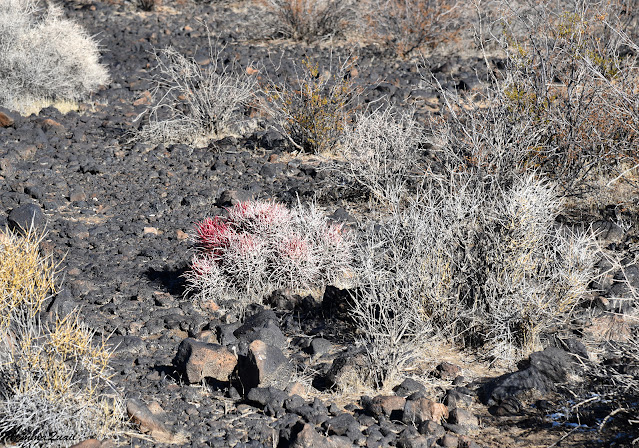
Cottontop Cactus, Echinocactos polycephalus

There weren't any Joshua trees near the cave. The tallest plants around were yucca, and even they were few and far between.
Banana Yucca, Yucca baccata

There was recent precipitation, we already knew that from driving through the snowy plateau. There were some puddles on the trail and as we stepped sideways to circumvent them we noticed that they were all frozen over.

The lava tube is underneath a little volcano butte and the trail to get there is short. I couldn't believe how short it was so I didn't pay attention, and while I blinked, I missed the turn to the butte. We therefore continued about a third of a mile  north before realizing that we overshot our turn and needed to backtrack some.
Another butte

I wasn't upset about the extra walk - we were in a beautiful area and we also got to see the only wildlife on this hike - an American kestrel hovering in the sky, hoping to get lucky.
American Kestrel

The way to the cave's opening was a narrow foot path that diverged from the very graded road we were on. It ascends in a mild slope towards the entrance. As we approached I could hear other people underground, below me.
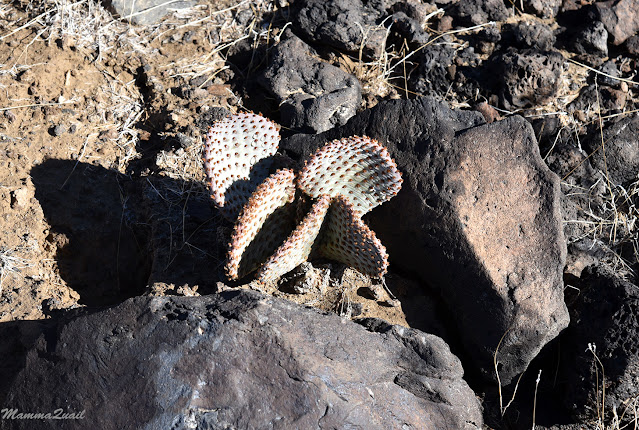
Beavertail, Opuntia basilaris

Pappa Quail and the chika went up ahead of me while I paused to look at pretty things along the way. Lichen fascinate me, and they are a common sight, but nice lush moss cushions are a less common sight in the desert. That patch of moss was well hidden in the shaded, north-facing side of the rock.

The voices from underground intensified. There was a hole in the ground left of the path where the voices were coming from. It was dark inside and I couldn't see anyone, but I heard at least 3 people there, two if them children.

When we reached the cave's opening the people that were in there were in the process of getting out so we waited for them to clear the path. Meanwhile I looked up and saw that the trail continued up the butte. The thought of going up there after the cave visit did cross my mind, but I had already planned another hike for us after the cave.

Beyond the butte at the base of which we stood was another butte and we were looking on its north-facing slope which was covered with snow. I imagined stretching my arm all the way and touching it.

The family with the kids were out of the cave and we started going down ourselves. We had two flashlights and one small reading light. I gave them all to Pappa Quail and the chikas and used my phone light to illuminate my way.

To be honest, I don't think a flashlight is really necessary there. There are  a couple of holes in the cave's ceiling that let in enough light to see, once the eyes get used to the dimness. The flashlights however, do allow to see the nuances and the more delicate features of the the cave, such as the solidified lava drips that protrude from the ceiling like tiny stalactites.

Unlike the Subway Cave, the Mojave Lava Tube isn't accessible from both side and has only one opening for entering and exiting. It is also pretty short - just two small 'rooms' connected by a short underpass that requires bending to go through. There was a dark hole at the end of the cave and perhaps I could have crawled into it but I chose not to do that. Instead we looked around some more, then turned back and went outside.

On our was back to the car I kept looking around, gazing wistfully at the other buttes. This entire area was like a candy store that we were allowed only a brief visit in.


Perhaps I could have convinced the others to continue exploring the buttes but the chikas had their own ideas, mainly concerning something like 'lunchtime'. So we drove back to the Kelso Visitor Center (which was closed still) to have a picnic before going to explore the lava beds area in the park.


Wednesday, December 25, 2019

Going Underground: Hiking to and inside Pluto's Cave

Spelunking 101

Date: November 25, 2019
Place: Pluto's Cave, Weed, California
Coordinates:41.571337, -122.279208
Length: about 2 miles including inside the cave
Level: challenging - involving much rock scrambling. Must take flashlights inside.

I always held fascination with caves, and whenever there is an opportunity I'll happily go into one for exploration. I'm please to say that my chikas share this fascination and are enthusiastic about cave exploration as well.
That said, most of the caves we visited in California were tamed with cemented trails and stairs, electric lights and guided tours. Occasionally we do get to explore a wild cave that hasn't been tamed or capitalized on, and Pluto's Cave is such. It had been on my wanna go there list for quite some time and last November I finally got the chance to go there.
Pluto's Cave Trailhead
The chikas' school was out for the entire week of Thanksgiving but Pappa Quail was still at work so I invited the chikas best friend and took all three on a three days vacation in the area of Redding. On Monday we had a lovely day in which we toured the Shasta Lake Dam and after that drove northeast to Weed. As the day progressed the weather changed from clear and windy to cloudy and windier. We stopped at the town of Mt. Shasta for a late lunch during which light precipitation begun - in the shape of flurries. I was a bit concerned but when we finally arrived at the Pluto's Cave trailhead northeast of Weed we were in dry land.
Late in the afternoon when we started down the trail. The sky was overcast and the air was very cold. We walked briskly, intending to get underground as soon as possible to avoid the cold wind.
Our hike as captured by my GPS.
The area of Pluto's Cave is a volcanic high desert. We walked on a narrow path of volcanic sand that was very dry despite recent rains. The ground was covered with sagebrush and sparse junipers. A couple of hikers returning from the cave came down the trail and paused for a quick chat. They described a short tunnel with a high ceiling and a steep pass on the other side. It didn't sound like the descriptionI read of the cave but I figured we'll soon find out for ourselves how the cave was. After these two hikers went on their way we were left all alone in the wilderness.
Junipers along the trail
Pluto's Cave is a lava tube, created when volcanic lava flow that crusted on the outside while the inside liquid lava drained away, leaving a tubular tunnel. The lava beds of the Cascade volcanoes in Northern California have many such lava tubes. A few of these caves, like those at the Lava Beds National Monument or The Subway Cave are arranged for visitors. Others are more 'wild', without artificial light, arranged trails, or even a spot on the map.
Pluto's Cave has a spot on the map with a small parking area, a trailhead and an access trail. It even has an entry in the Klamath National Forest website, but that's all. Otherwise, this cave is not managed in any way.
The Side Arch 
Lava tubes become exposed when the ceiling collapses. Naturally, people are not the only explorers who find and enter these caves. As we descended into the collapse area at the end of the access trail the chikas noticed a bird's nest up on a ledge right below the ceiling. The nest's builder wasn't there. I assume it moved someplace warmer for the winter.
Bird's Nest
A large gaping hole at the left side of the collapse area leads to a short tube that ends with a high opening. It is possible to climb there but we didn't. We explored this shorter tunnel for a few minutes, then returned to the collapse area and moved to the main cave's entrance on the right.
The Side Arch from inside
It isn't easy to see the main opening of Pluto's Cave because the entrance is low arched and because of the tall vegetation that grows in the collapsed area. All the bushes were bare while we were there so it didn't take us long to locate the entrance. We pushed through the vegetation along the narrow foot path toward the gaping dark hole.
Pluto's Cave's Entrance
Switching on the headlights we plunged into the darkness. The cave's floor wasn't flat and nice to walk on as that of The Subway Cave. Far from it- it was piles and piles of rocks, broken off the cave's ceiling. We had to carefully walk around or over these rocs and our progress was very slow.
Into the Darkness
It didn't take long however, before we saw light again - through a round hole in the cave's ceiling.
A Window of Light
The next bit of dark cave wasn't long either - we soon came into another place where the cave collapsed. Like the collapse area at the cave's entrance, this too was filled with tall bushes bare of leaves. The path here was much narrower and harder to walk through. It seems that much fewer people went this far.
In Between
Past the second collapse area we plunged once again into the darkness, and this time with no more 'windows'. By then I also realized that my headlight was low on battery and had to use my phone's flashlight app which slowed my progress whenever I needed to use my hands to climb the rocks.
The kids exploring a hole below the path
The cave was certainly more rugged as we moved forward underground. I read that it goes nearly a mile underground and that further on progress requires crawling in tight places. We didn't get that far, maybe a third of a mile altogether. We came to a stop at a large boulder that seemed to block the main tunnel. There was no path under it and going over and around it would have required more serious climbing than any of us was ready to do at the time. The kids were ready to turn around at that point.

Before turning around however, the elder chika noticed a dark spot at the wall and called our attention to it - it was a bat! One of several we've seen in the cave that day, and the nearest one to us. Still, we avoided getting to close to it as to not bother it from its winter hibernation. Pretty exciting though!
Townsend's Big-eared Bat, in hibernation
As I mentioned above Pluto's Cave is not managed. That, however, has a big downside to it, which is that it is also not protected. Despite this cave being wild and natural, people seemed to have no respect to it. I was sad to see that much of the cave walls were defaced with graffiti.
While a few of the graffiti had some sort of artistic merit, most were simply junk. Either way, none of these belong in there and seeing it bothered me greatly.
Graffiti 
Going back was faster than going in. We didn't stop as often to explore and once we've seen the faint light coming through the collapse holes we moved directly that way.

It was already late in the afternoon and also overcast, so the night filtering into the cave was faint. Still, t seemed bright compared with the total darkness inside.

Outside in the in-between collapse area I could tell that evening was at hand. It seemed though that we might have just enough daylight left to walk the long way back so I suggested it to the kids and they accepted.

I had misjudges how quickly the light was fading. It was already after sunset when we took the longer route back. At first there was no problem telling where the trail was. We were walking on a narrow foot path with the wonderful view of the high desert around us and the peaks looming over the lava beds.

Soon however, it became difficult to tell where the trail was and more than once I had to navigate cross country in what I knew to be the general direction of the trailhead.

We arrived at the parking area at nearly total darkness. The wind had picked up and the kids were grateful to get inside the car and away from the whipping gusts. I took a few minutes longer to walk around the parking area and take in the wild sights - I don't know when next I'll have the chance to get to that place.
Juniper at nightfall
Eventually I too got inside the car and we drove away back to Redding. 
We've had a number of nice hikes and other fun activities on the three days we spent in the Redding area before Thanksgiving but our spelunking hike at the Pluto's Cave turned out to be the highlight of our trip for the kids - the most memorable and exciting thing the did. It sure was so for me too!