Sunday, September 15, 2013

A Hole in the Ground Where the Wind Does Not Go: Inside Ubehebe

Date: March 8, 2013
Place: Ubehebe Crater, Death Valley National Park, California
Coordinates: 37.01083, -117.45490
Difficulty: strenuous

On the morning my friend and I had left Panamint Springs, the looming storm was still looming. After spending some time looking for wildlife around the ghost town of Ballarat we headed eastward over the mountains and into Death Valley itself. By then, large raindrops were falling and the smell of first rain (in the desert almost every rain has that first rain smell) filled the air. Of the bloom spectacle I promised my friend, there was no sight. The valley, however, was not barren. Little yellow flowers dotted the wide gaps between the Creosote and brittlebush shrubs: Desert sunflower, all over the place!

And up close. The lively bright yellow was a much appreciated sight in the otherwise pre-storm glum. The little suns on the earth made up well for the hidden sun in the sky!
Desert Sunflower (Garaea canescens)
I've been to Ubehebe Crater twice before, and even wrote about it here. I wanted to show it to my friend also. My plan was to walk around the rim. The wind, however, was so gusty and strong that we soon abandoned that idea. Instead, thinking to find refuge from the wind, we wend down the cinder trail into the crater itself.
The trail to to the bottom of Ubehebe
There is no hiking trail inside the crater. Once down (and away from the wind) we simply wandered about, looking for interesting sights, and easily finding them. I was impressed by the layers of packed volcanic ash that make the colorful eastern wall of the crater.
The eastern wall of Ubehebe
Run-off water had cut narrow crevices into the crater walls. It was very tempting to squeeze into them and see how far back they extended.

None extended very far. Still, it was an interesting experience.
The trail and the western crater wall, viewed from inside a crevice
 The crater is a basin with no way out. Run-off water evaporate, leaving a flat and smooth surface at the lowest part of the crater. At this place, where water is last to leave into the air, the Creosote bushes are the largest and lushest. Right there, these bushes are as tall as a person.

Surrounding the evaporation plain, the bottom of the crater is strewn with colorful rocks that make a pretty mosaic between the Creosote bushes.

And not just the rocks are colorful there: the unassuming grayness of the desert holly shrub is dotted with scarlet flowers.
Desert Holly (Atriplex hymenelytra). Photo by עננת
 Taking Papa Quail's advice, I am adding here a rim photo of Ubehebe, to give a proper scale of where we've been on this visit. I missed taking a rim photo on this visit, so this photo is pasted from my previous hike there, on October 2011.
Ubehebe - an almost full view. Taken on October 2011.
We wandered for a good hour at the bottom of Ubehebe. Going back up was not easy: the cinders trail takes much effort to ascend and the wind increased with every step upward. We didn't stay long at the top. huddled in our winter clothing we escaped into the shelter of the car and continued south to Death Valley, facing the on-coming storm.  

Many thanks to my friend עננת for identifying the plants and for allowing me to use her desert holly photo.


Friday, September 13, 2013

The Desert's Lifeline: Darwin Falls at Panamint Springs

Date: March 7, 2013
Place: Panamint Springs, Death Valley National Park, California
Trailhead coordinates: 36.32756, -117.51471
Length: about 2 miles in and out
Difficulty: easy to moderate (involves some rock scrambling near the falls).

The winter of 2012-2013 has been by big desert winter. After touring the desert parks of Anza Borrego State Park, and more desert parks in Imperial and Riverside counties over winter break, I was ready to travel south again: this time with my botanist friend from overseas.
"Come in March and I'll show you the spectacular desert bloom!" I told her, back in Fall. I also suggested camping in the desert, and my friend was concerned that it might be too cold for that.
"Cold won't be a problem," I assured her. "Not where we're going, not on that time of year."
So my friend arrived, and as it turned out, I was grossly mistaken on both accounts. After a relatively dry winter, there were very few wildflowers about and the week we were there turned out to be the coldest of that winter. That taught be not to promise anything that's beyond my control (although I was ready to promise anything so my friend would come to visit, and my predictions would be accurate any other year ... )

Either way, I left the chikas in the excellent care of Papa Quail and took off with my friend into the vast California desert.
Snow-capped Telescope Peak, viewed from Father Crawly Vista
All of my previous visits to Death Valley National Park, I somehow managed to pass Panamint Valley on my way to the more popular attractions of the park. This time I added it to our tour plan and I am very glad I did so :-)
Cottonwood Mountains Northeast of Panamint Valley, viewed from Father Crawley Vista
Panamint Springs is a small resort in Panamint Valley, inside Death Valley National Park, just west of Death Valley itself. There's fresh water there. Precious spring water in the middle of a vast desert that sustains that tiny resort of Panamint Springs. Lucky for us, we got there on time to book nearly the last available room in the resort. There is the campground there too, and that's where we sat down for a picnic lunch, admiring the beauty of the sparrows that hopped about.
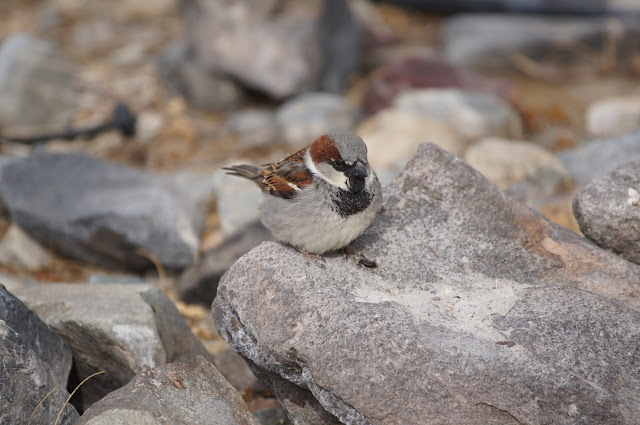
House Sparrow, male
After lunch we drove the 2-miles dirt road to the trailhead to Darwin Falls. Along the way we saw the thin, white pipe: the lifeline of Panamint Springs from the only fresh water source in the area.

The dirt road continues beyond the trailhead and onto the hills. We parked and entered the Darwin Wash. Not quite spring yet, but the silvery cushions of brittlebush were in bloom.
Brittlebush (Encelia farinosa)
Other shrubs added their bright colors to the desert brown:
Pygmycedar (Peucephyllum schottii)
But even the desert brown has many shades and colors. These tell of the natural history of the Earth there at that spot:
A dike: a sheet of magma that rose in a rock crack and froze there, exposed by the wash water
The water pipe was going along with us, all the way to the source. With so little water available, every drop consumed by people is a precious drop less for the wild. A fine balance it is, to use and not destroy. The pipe wasn't completely tight and at some points, some of this precious water was returned back to the wild.

About that point we also met with the natural water flow of the Darwin Wash, all covered with algae:

After about half a mile the canyon was closing in on us and lovely lush willow trees filled the gap between its rocky walls. My spirit swells at the sight of the lush green against the bare desert scenery.
Salix sp.
But no one could say that desert color comes only from plants. In the desert, the rock itself is alive with color!

But the plants do add to the color splendor. Some were easily approached,
Emory's Rock Daisy (Perityle emoryi)
And some we had to admire from afar.
Hedgehog Cactus (Echinocereus sp.)
A fern in the desert. What a luxury! It marked the cracks in the rock where water was seeping from the ground.
Maidenhair Fern (Adiantum capillus-veneris)
And just above the fresh water source, a beavertail cactus growing on completely dry rock.
Beavertail Cactus (Opuntia basilaris)
Along the creek we saw numerous plants that one would not find in the area at all if not for the springs.

And lucky for us - a few of them were in bloom.
Golden Suncup (Camissonia brevipes)
As for wildlife, the chirping of birds was everywhere to be heard. Seeing them, was another matter altogether. After much patience, I managed to get a clear view of one of the happy singers: a Yellow-rumped warbler:
Yellow-rumped Warbler
Their nests are stationary, making them an easier subject to photograph.
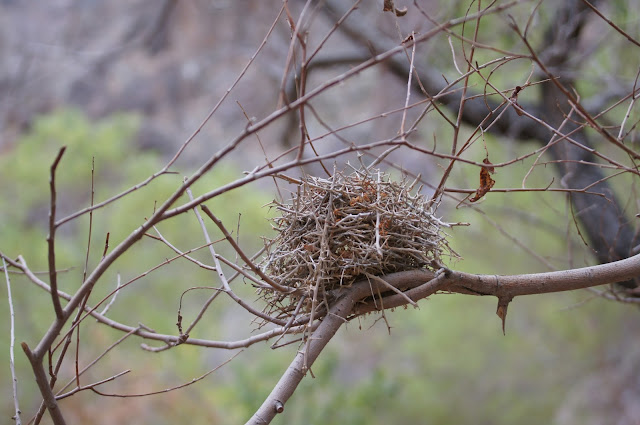
Yellow-rumped Warbler's nest
Some of the birds can be difficult to see because they hide in the vegetation. Others are difficult to see because they blend in their surroundings, wearing perfect camouflage:
Say's Phoebe

Some birds, however, stand out proudly in full color, like this lovely robin who stood his ground and allowed us to get quite near for a photo:
American Robin

We kept on going toward the falls. At that point the comfortable trail becomes hard rock and we spent considerable time jumping from one side of the creek to the other to find good footing and to keep our shoes dry and our clothes clean of thorns.
Scrambling to the falls
There is an abundance of beautiful waterfalls in California, many of them are very impressive. Darwin Falls is small and modest but, like in many other things, it is all about location. Being where it is, Darwin Falls is one of the loveliest waterfalls I've seen in this state.
We were alone there, my friend and I, and had it not been so cold and windy, we probably would have enjoyed a swim in that little pool under the waterfall. But then again, had it been hot and sunny, we probably would have had to share the sight and the fresh water with other hikers.
As it was, we enjoyed the solitude and the pure sound of falling water and chirping birds.
Darwin Falls, named after the American Adventurer Darwin French.
The sky was getting dark, and not just because it was getting late. After a long rest my friend and I hoisted our backpacks and headed back down the wash. Ahead we could see the heavy clouds moving in. It was time for to get back indoors.
Signs of on-coming storm

Many thanks to my friend, עננת for identifying the plants!

Friday, August 30, 2013

The Butterfly Realm of Giants: Mariposa Grove and Wawona Point


Giant Sequoia (Sequoiadendron giganteum)
Date: June 18, 2013
Place: Mariposa Grove of Giant Sequoia, Yosemite National Park, California
Difficulty: moderate to strenuous

A day after taking my friends to Vernal Fall and Mirror Lake I took them to see the giant sequoias. Yosemite National Park is, among many other things, a home to some of the most impressive groves of Giant Sequoia: the most massive tree on Earth. The Mariposa Grove, located at the southern tip of the park, is one of the oldest known and most explored one. It is also the first one to become protected by the Act for the Yosemite Grant, much due to the efforts of Galen Clark, the first European-descent to discover the grove.
The trunk of a mature Giant Sequoia tree
To the visitor's convenience, there is a tram that goes on an interpretive route up and around some of the landmark trees. The tram stops at the little Galen Clark museum at the upper grove and those who wish can hike back down through the forest. So did we.
I've hiked in that area several times before and the bis trees are always impressive. It was my first time, though, to have noticed the festival of wildflowers that was going on there in full force.
Wild California Rose (Rosa californica)
While spring flowers were gone from the bay area, at the Sierra Nevada mountains they were at the peak of their bloom.
Alpine Lily (Sierra Tiger Lily, Lilium parvum)
My friends got neck pains from bending up looking at the canopies. I got neck pains from bending down to the wildflowers! 
Broad-leaved Lotus (Hosackia crassifolia)
There is a web of trails all over the mountain, connecting one landmark sequoia to another. I did my duty as a tour guide and led my friends to many of them. This one, the Telescope Tree, has been hollowed by fire years ago and survived. One can go inside the tree and, looking up, see the sky.
Inside the Telescope Tree
Giant sequoia are amazing trees. Not only can they live to 3000 years and hold the world's biomass record, but they are also fairly fire resistant, due to the high level of tannins in their bark, which also give them the reddish hue. The forests of the Sierra Nevada mountain range are subject to frequent fires that have become a significant factor in shaping the area's ecology. The fire scars on many of the giant sequoia there are evidence of such fires. Thick cambium growth over the char marks tell the time passed since the fire.
The root crown of a fallen tree

Giant Sequoia also form a community by linking their roots underground. However, the roots of these massive trees are anything but massive. In fact, they are very sensitive and easy to damage. This was learned at the sad price of tree death due to too much human activity around and tampering with the trees. Such was the fate of the famous 'Tunnel Tree' that was weakened by the tunnel carved in it and eventually collapsed in the winter of 1968. Nowadays, landmark trees are fenced, and visitors are advised not to come up to the trees and stomp on their delicate roots.
The parasitic Snowplant (Sarcodes sanguinea) growing under the Sequoia

The wood of the Giant Sequoia is brittle and no good for construction. Very lucky for this species!
We walked from one tree to another, and I continued to enjoy the colorful spring spectacle of the forest.
Douglas' Iris (Iris douglasiana)
Then, after passing the tree named after Galen Clark, I seduced my company to hike up to the top of the mountain: to Wawona Point.
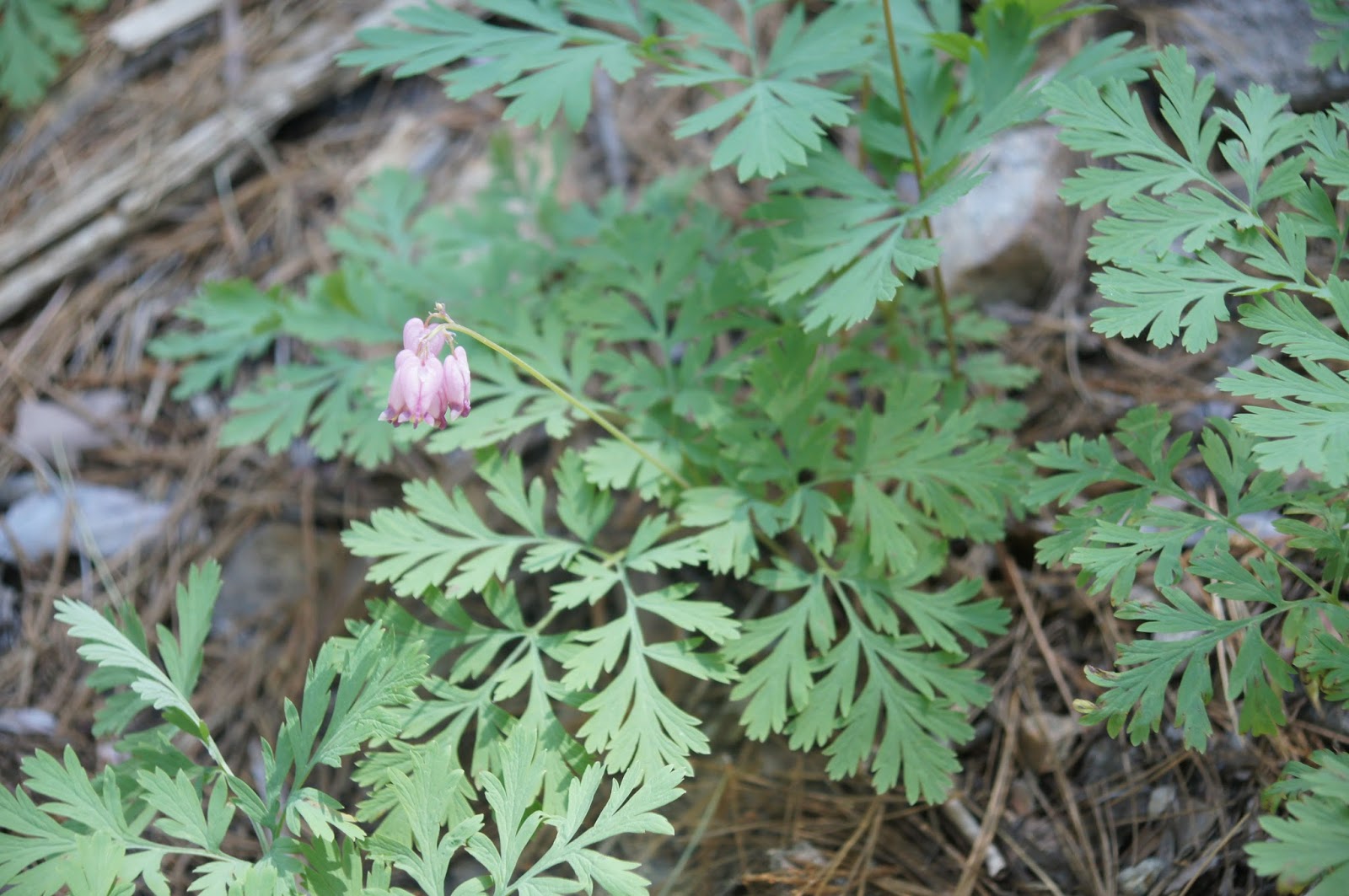
Pacific Bleeding Heart (Dicentra formosa)

It is only half a mile more, and the view is worth it. The children grumbled, but we went there anyway. There are no giants there but many wildflowers still.
Leichtlin Mariposa Lily (Calochortus leichtinii)
And the view from Wawona Point was indeed breath taking.
View North from Wawona Point
My chicas thought that the bright lawn below (yes, it is a golf course) look like a bunny rabbit :-) The haze is from the smoke of a fire that was going on southeast of Yosemite that day.

We had a long rest stop there, enjoying the view.

View East from Wawona Point
Eventually we started walking back. I don't remember how (maybe it's denial) but somehow the word 'tram' was heard. That word ignited an all out mutiny among my company, and after a very short discussion we returned to the Galen Clark Museum where I saw everyone, including my chicas, off to the tram, promising to beat them to the parking lot on foot.

I didn't beat them there, but I can excuse my tardiness by all the beautiful wildflowers I saw on my way down (of which I only present a small selection here).
Floral buds of White-veined Wintergreen (Pyrola picta)
I can't really blame my friends for deserting me. After all, I did drive them pretty hard on the previous day, dragging them all the way up to Vernal Fall. I was also in a very happy mood: now I could enjoy the forest beauty in peace.
Narrow-leaved Lotus (Hosackia oblongifolia)
My company (especially the younger ones) had a good time too: they raided the gift shop and had ice cream. So everyone had their pleasure.
Forest Clarkia (Clarkia rhomboidea)
The trail downhill goes through a drier area where no Sequoia trees grow. Many other trees do, however, and the pine and cedar forest is very beautiful too.

The trail leads back to the landmark trees of the lower grove, where it goes through the California Tunnel Tree which still stands, and visitors take their pictures inside it. It gives one a bit of a feel to the size of this tree.
The California Tunnel Tree
The foot trail also took me right by the biggest tree in the grove and one of the biggest in the entire world: The Grizzly Giant. 34,005 cubic feet of wood. Its limbs are as big as trunks of nearby trees. My photo really doesn't do it justice, so you must go there and see it for yourselves.

The Grizzly Giant 
Dizzy with delight I made it back to the parking lot and found my company slouching by the gift shop and my young chica's teeth gleaming in a joyous grin in the dark frame of chocolate ice cream that covered her face.
That was the end of the brief intro to Yosemite I took my friends to this summer. I don't know when would be my next visit to this magnificent park, but next time I will probably try to see more of the wilderness areas and less of the tourist hot spots. Next summer, perhaps?


Many thanks to members of the California Native Plants Society for their help in identifying plants!