

Date: March 30, 2022
Place: Glory Hole Recreation Area, Carson Hill, California
Coordinates: 38.015053, -120.525427
Length: 4.1 miles
Level: moderate
Last April I had plans to take my family hiking group on a camping trip to the Gold Country. I had a group campground reserved in Tuttletown Recreation Area and plans for four nice trails to hike in the area. A few weeks before the trip date I received a message from the campground agency informing me that it will be closed from April 1 all through summer and that I should find an alternative campground for my plans. Well, I did look for an alternative but by that time all the area's group campgrounds were already booked. We had to give up the camping part of the trip but we decided to go on with our hiking plans. I did have to change one of the planned trail though, because the original would have been the Heron Point hike in the closed off area. The Carson Creek loop trail seemed to be a good alternative so I went there on my own at the end of March to check this trail's suitability for a group of families.
 |
| My hike as captured by my GPS |
This post is about my solo hike but I also included a few photos from the group hike which took place two weeks later. One of these photos is the one below, taken at the loop's trailhead, with a very nice display of the California spring colors of orange poppies and the blue sky lupine.
 |
| April 9 |
The marked trailhead leads directly west and downhill toward the lake. I decided to do the loop in the clockwise direction, so I crossed the road and started down the wide dirt road in the direction of the Glory Hole campground. It was a nice day, with light feathery clouds floating in a mostly blue sky. The air was cool though, not as warm as I thought it might be in this time of year.

There were many storksbill flowers blooming along the trail, and a few phacelia, but when I came back on April 9, I also saw this little one blooming.
 |
| April 9 |
While still on the high ground I had a grand view of the lake's area. Not of the lake itself though, because it was covered with fog.

At the bottom of the dirt road I had to cross the asphalt road again, the one leading into the campground and the boat ramp. There was a small parking lot there and the beginning of a foot trail leading south to the waterline. Green still, yet already maturing grass covered the hillside, most of it being tall wild oats. Lilac-colored Ithuriel's Spear flowers poked through the grass, bobbing in the light breeze.
 |
| Ithuriel's Spear, Triteleia laxa |
Large oak trees dotted the open grassland of the hillside. These beautiful trees looked very peaceful but even from a considerable distance I could hear that there was much action in their canopies.
 |
| Carson Creek Trail |
A family (or two competing families) were raising a lot of noise chasing one another in the canopies of three adjacent oaks. Fascinated, I watched them for a good long time until they all flew away to a more distant oak.
 |
| Acorn woodpeckers |
I commenced my hike. Little bicolor lupines, still wet with dew, marked the edges of my trail. I assume there were many more of these lupines up the slope but I couldn't see them because of the tall grass.
 |
| Lupine, Lupinus bicolor |
The fog had lifted, and around the curve I got my first look of the lake. The New Melones Lake was built in the first part of the 20th century, and its dam raised again in the sixties. Unlike natural lake, this man made lakes don't have the streamlined shore formed in many years of erosion. Instead it looks like a strange amoeba with many 'arms' stretching in every direction where a source creek flows into it. My first view of the lake was one such 'arm' and I spotted a boat camp dock in the middle of it.
 |
| New Melones Lake |
I reached a four-way trail junction where a smaller loop branches of around a small land point and of course I took it. The path was narrow, cutting through oak savannah of tall grass and graceful oak trees.
 |
| Carson Creek Trail |
I started seeing large patches of blue. These were carpets of sky lupine. Even in this dry year I got to see some grand spring bloom after all.
 |
| Sky Lupine, Lupinus nanus |
I reached the lake's shoreline and I was now walking around the cove. During the Gold Rush era there was a small mining community downhill of where I now walked, named Jackass Hill. Jackass Hill is known as the place where Samuel Clemens lived for 88 days during the Gold Rush era, and where he got his materials for the stories he would later publish under the pen name of Mark Twain.
Jackass Hill along with a few other mining communities where abandoned and their remains removed and later flooded when the New Melones dam was built.
 |
| New Melones Reservoir |
Little tarplants were blooming between the grasses. I thought it was a bit early in the season for them, their bloom usually peaks mid-summer. I like these hardy little plants with their delicate inflorescences.
 |
| Tarplant |
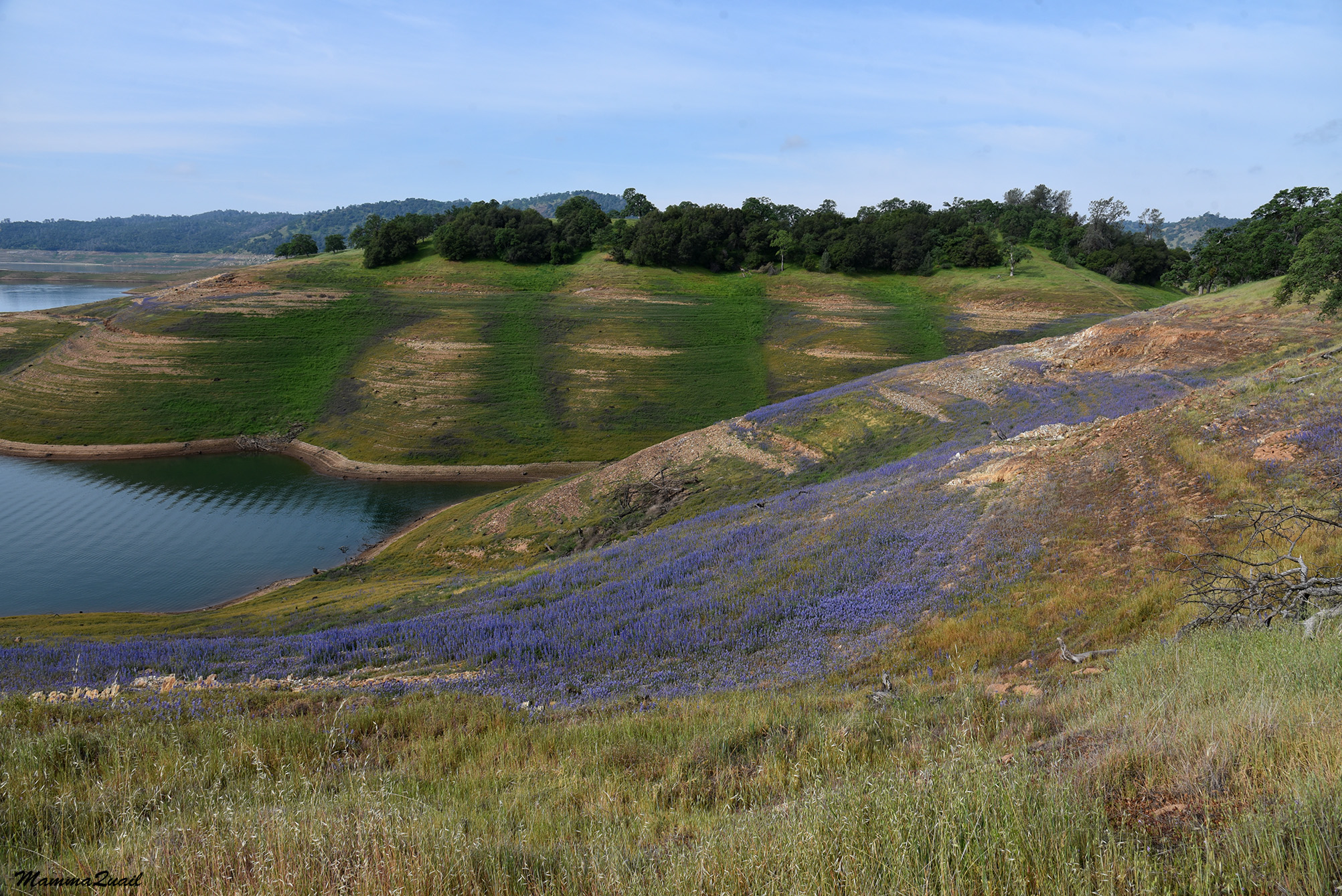
When I reached the lake and looked down I stopped and gasped. The water level was low, which wasn't at all surprising considering the dry winters we've had the last couple of years. What awed me was the purple carpets of lupines that covered the slopes below me. I assumed they were sky lupine like those I've seen earlier along the trail but I couldn't tell from that distance.
Closer to me were lovely patches of fiddleneck flowers, named so for the curl of their inflorescence stem.
 |
| Fiddleneck |
I looked behind me at the green oak savannah and the mild foothills rolling under the horizon, then moved on to complete the smaller loop around the cove.

After reconnecting with the main loop trail I continued walking above the lake's shoreline. In the originally planned hike at the Tuttletown Recreation Area I had in mind to get my group down to the water for some beach time but on this hike I would have to give up the idea. The water was too low and the slopes were too steep and there was no convenient access to the water anywhere along this trail. What we would have was the amazing lupine carpets stretching from trail to water.
 |
| Lupine Field |
Dry little creeks formed inlets leading to the lake and the trail undulated around them, temporarily leaving the shoreline only to return to it after the curve. I was surrounded by the lovely green oak savannah. I saw that the wild oats and the other grasses were already maturing and I thought to myself that this lovely scenery won't stay green for long.
 |
| March 30, Carson Creek Trail |
Indeed, less than two weeks after, the grasses were already drying out.
 |
| April 9, Carson Creek Trail |
Returning to the lakeshore from one of these trail curves I noticed a different kind of lupine, which bloomed in white. I do sometimes see a white individual of a more commonly blue species, but these white lupines made their own patches separate from the blue ones.
 |
| Large-leaved Lupine, Lupinus polyphillus |
The trail curved north and I was walking on the east-facing slope. There were more areas of exposed rock face along that part of the trail. There were other tree species as well, besides the ubiquitous oaks.
 |
| California Buckeye, Aesculus californica |
That part of the trail was also much more shaded and lush. I saw different wildflowers there as well, Including the Franciscan onion which was just beginning to bloom.
 |
| Mexicali Onion, Allium peninsulare |
The pretty face triteleya, a relative of the Ithuriel's Spear, was blooming there as well, ad was still in the beginning of its season.
 |
| Pretty Face, Triteeia ixioides |
May 30th was a nice cool day but on April 9 it was already fairly hot and we were all grateful for the nice shade cast by the trees along that part of the hike. Anticipating the April heat I planned the group hike to be in the same direction as I hiked it on the prep-hike on March 30, so that the uphill part will be as shaded as could be.
 |
| Carson Creek Trail |
I was going steadily uphill now, at a mild slope and a mostly shaded trail. Mule-ear plants were also blooming on the east-facing slope and it looked like they were already peaking at the time. I really love these sunflower-like plants.
 |
| Smooth Mule Ears, Wyethia glabra |
Another very common plant that was growing primarily along the east-facing slope was the poison oak, a plant that I leaned to recognize in each of its numerous forms.
 |
| Poison Oak, Toxicodendron diversilobum |
I was surprised to come across a grand iris flower. I didn't recognize the species but I knew immediately that it is not a California native. The grand irises are from the Middle East part of the world.
 |
| Iris sp. |
As far as I know, only humans are sensitive to poison oak. It is in fact, a keystone species in the west coast states, a staple which supports many, many animal species. This beetle that I saw on my later hike gets at least physical support from the poison oak.
 |
| April 9 |
The sunny areas on the east-facing slope displayed a variety of wildflowers very different from what I saw until then. For one I saw patches of the plant with the name that so fits the California Gold Country.
 |
| Carson Creek Trail |
Then, there were the tiny linanthus flowers, each of them so small that it is barely noticeable, but in patches it colors the rocky outcrops so beautifully.
 |
| Leptosiphon sp. |
Between the patches and carpets of the goldfields and other flowers bloomed delicate tomcat clover plants, peeking through with their intense purple flowers.
 |
| Goldfields, Lasthenia californica and Tomcat Clover, Trifolium willdenovii |
The rock ledges sheltered white phacelia flowers, similar to those I've seen on the first part of my hike, on my way down to the lake.
 |
| Phacelia |
The trail was very narrow and I didn't have the space to take a broad enough photo of the pretty rock layers where they were exposed along that part of the trail.

I was able to get a nice close up of another species of lupine that was crowing next to that rock.
 |
| Spider Lupine, Lupinus benthamii |
Very close to the spider lupine bloomed another lupine, bearing white flowers. It looked different than the other white lupines that I saw blooming between the trail and the water. I wonder if that could be a white variant of the sky lupine.
 |
| Lupinus nunus? |
Another cool find along that part of the trail was the narrow-leaved owl's clover. This relative of the Indian paintbrush is really easy to miss if one isn't searching the ground for the less bold flowers.
 |
| Narrow-leaved Owl's Clover, Castilleja attenuata |
Eventually the trail curved west and I entered the final lag of switchbacks on the way up. On one of the switchbacks the trail stretched between thick bushes of poison oak and low buckeye trees.
 |
| Carson Creek Trail |
Many of these bushes were covered with a pretty floral blanket of clematis vines. When these go to fruit they look just as lovely with their Traffula-tree looking seed heads.
 |
| Clematis on Poison Oak |
I made my way quickly uphill going back and forth on the switchbacks. Soon I was high enough to get a nice view of the other side of the cove, a view that up until then was hidden by the trees below. Above the horizon loomed some serious-looking clouds and I wondered if there will be any rain soon.

There wasn't any rain coming as of yet, but the wind picked up and was whipping hard at the trees and grasses. I picked up my pace as well.
 |
| Carson Creek Trail |
A strong smell of chamomile filled my nostrils. I looked down and recognized the pineapple weed, a California native relative of that wonderful Middle-Eastern tea herb. These little plants love growing in the middle of dirt trails and I had stepped on some of them, releasing their strong aroma into the air.
 |
| Pineapple Weed, Matricaria discoides |
I was surprised to see some shooting star flowers near the trail there. It was already fairly late in the season for these.
 |
| Shooting Star, Primula hendersonii |
Two weeks later the shooting stars were no longer blooming. On the second hike however, a nice spotted lizard was waiting for us on that part of the trail. It stayed there, eyeing us for a good, long time, before sliding into the vegetation and vacating the trail.
 |
| April 9 |
I was nearly at the top when I turned around and looked behind me at the cove I rose above. I could see the water below. Once more I noted how low the water level was. It would get lower still throughout the summer. We really need a good, wet winter soon.

Throughout my entire solo hike I was looking for places that would be good for a large group to stop and sit for a break, and I couldn't find any such places. I did see one however, just before the end of the hike ... A perfect place shaded by old, dark oak trees. Well, almost perfect. The undergrowth was all poison oak.
 |
| Carson Creek Trail |
The last part of the trail was again the familiar oak savannah that I started with. The blue completely disappeared from the sky and a thick layer of clouds hung low above me.
 |
| Carson Creek Trail |
 |
| California Poppy, Eschscholzia californica |
By the end of my hike I was hungry. A sole, lichen-covered picnic table was under an oak tree by the side of the small parking area. A single bluebird was perched on the table and allowed me to get really close before flying away. I sat at the table for a quick lunch, turning my back to the wind. This trail would be suitable, a good replacement for the originally planned Tuttletown trail.
 |
| Western Bluebird, male |
Indeed it was. The group hike of April 9 was a very enjoyable one. This trail makes a fine spring hike, a good wildflowers spot.
Many thanks to members of the California Native Plants Society for their help in identifying plants.


