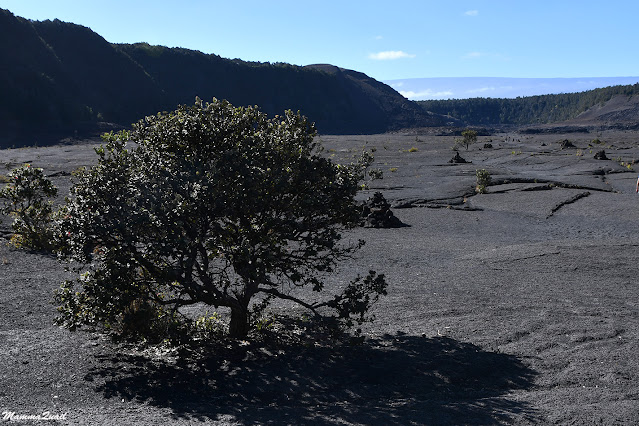
Showing posts with label The Big Island. Show all posts

Friday, March 25, 2022

The Place to Finish the Big Island's Adventure: Captain Cook Monument at Kealakekua Bay


Date: January 24, 2020
Place: Kealakekua Bay State Park, Captain Cook, Hawai'i, Hawaii
Coordinates: 19.492317, -155.917945
Length: 4 miles in and out
Level: strenuous
 
Town of Captain Cook
Park's name is: Kealakekua Bay State Historic Park. The monument is at Ka'awaloa Cove

On February 14, 1779 the amazing career of the explorer Captain James Cook came to its end when he was killed in a fight with Hawaiian warriors at Kealakekua Bay. Today there's a town there, above the ocean, named Captain Cook. The bay and the surrounding area is a state park and by the water there is a monument for Captain Cook. I wanted to visit this place already on my first trip to Hawaii 18 years ago, but it didn't happen then. I hoped to go there on this current trip with my friends but we've filled our days at the Big Island already.  We hiked Kaloko-Honokōhau State Historic Park on our first day, at Hawaii Volcanos National Park on our second day, and an exploration day on the northeast side of the island on our third day. Our forth day was our last and we needed to be at the Kona airport by 1:00 pm to catch the flight to Maui. Since Captain Cook isn't far from Kona my friends suggested that we'd go there rather than pass our morning shopping or strolling on the beach. I jumped on the idea with glee and after checking out our lodge we drove south to the town of Captain Cook. 
Our hike as captured by my GPS

 There is no standard parking lot near the trailhead. The trail begins just off the Napoopoo Rd. between people's home properties, in an overgrown vegetation area, and is easy to miss. There is a wide pullout on the other side of the road where cars can park and that's it. No signs, no facilities, not anything that says that this is a trail leading to a state park. There is very little traffic there, and a flock of feral chickens roam the road and its shoulders. 

The trail is narrow but apparently someone did try at some point to drive there, otherwise I don't know how this vehicle reached there where it was abandoned and gutted. It was an the first intriguing thing we saw when we started down that trail. 

On the first half a mile or so the trail descends at a very mild slope, between green walls of very tall vegetation, effectively concealing the town's houses on either side of the trail. There were some birds chirping about, but all we saw in terms of wildlife was a large, blue snail. 

It didn't take us long to get out of the thicket though. Soon enough we found ourselves walking in a more open area of A'ā basalt, old enough to support many plants that are adapted to the exposed, hot conditions of the rock with very little soil to hold on to. One such plant was the Kalanchoe, the one that propagates itself by creating little mini-me's at the edges of its leaves. These tiny plantlets then detach and drop to the ground where they set root and continue to grow into an adult plant that is an identical genetic copy of its parent. This way of vegetative propagation must be very successful because there were carpets of that kalanchoe all around.
Apparently this method of procreation doesn't eliminate the need for sex so these plants bloom as well, and they were all blooming all over the place at the time of our hike. 
Kalanchoe

there weren't many trees along that part of the trail and the trees we did see were mostly acacia-looking trees of a species I didn't recognize yet. These trees cast a very thin and ineffective shade. On our way down however, we didn't mind the lack of shade. 

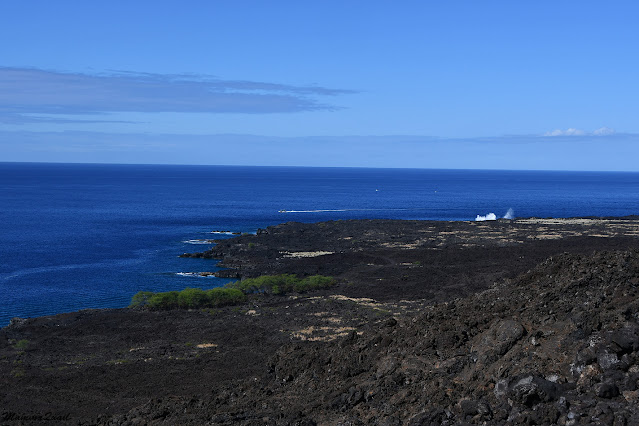
Then the trail dropped downhill in a steep grade. Below is lay the beautiful coast and the deep blue ocean lapping at the dark basalt ground (header photo of this blogpost). Directly below us was a small grove of palms and I assumed there was a fresh water source there. A spring, maybe. 

Most of the way down the slope was largely bare rocks. There was non need for any 
say on trail' signs. The A'ā rocks looked very hostile and uninviting. 

While still high above sea level we had a fantastic view of the southwestern coastline of the Big Island, and we could see the western slope of Kilauea descending mildly into the ocean. 
Southwest Coastline

A small group of butterflies erupted into the air nearby. They seemed to be chasing one another. I tried to capture them in the air and out of many blurry shots, one came out sot of near focused. It was a pretty sight to look at. 
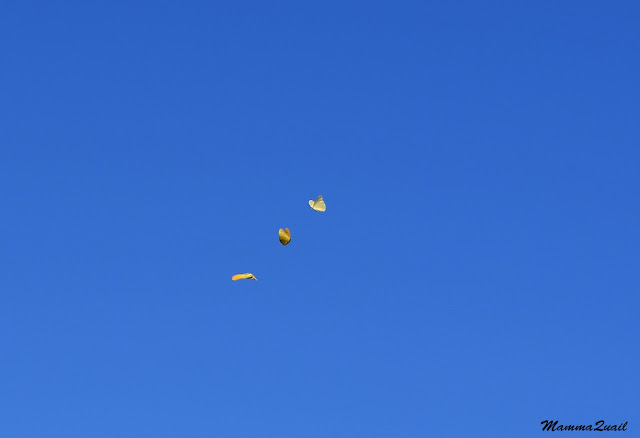
Butterflies

The trail got even steeper and we descended quickly, dropping down towards the green-belted blue. I couldn't tell our destination from where we were but I was already eager to get into the ocean. 

Getting down was quick. Then we turned south and walked a short distance on a level trail that was shaded by trees of several species, and some decorative bushes that I,m not sure were planted there on purpose.
Madagascar Periwinkle, Catharanthus roseus

There were evidence of people use of this place all over. There were many discarded beach items turned trash that gave the impression of an abandoned hippy joint. The thing that made it look most like a cheap hangout place was a stray cat that roamed around, looking of something to eat in the human leftover junk. 

As we neared the Captain Cook monument we started seeing people as well. There were a number of people in swimsuits and other beach attire sitting on the rocks around the monument. The real impressive sight was the bay itself: a couple of tour boats anchored near the shore and numerous human forms were floating face down with plastic pipes protruding from the sides of their heads. 

We of course, had full intention of joining the snorkelers. Before doing that however, I wanted to look at the Captain Cook monument, the primary reason for us going there. 

Captain Cook was a true explorer. Although he was a military man, he never took part in any conquest wars. Moreover, in all of his encounters with the native populations of the Pacific he kept the interactions respectful and straight forward, and enforced proper behavior on his crew. It is thought that the fight in which he lost his life started because of a cultural misunderstanding rather than a deliberate act of aggression on either side. Despite all that's known about Cook, the contemporary Hawaiians are irked by the Cook's memorial, because they see him as the one who opened the door to the stream of white settlers that eventually led to the loss of Hawaiian independence and the diminishing of their culture. 
The Cook Memorial

We changed to swimsuits, strapped the goggles and snorkel on our heads and stepped in the water. I had my underwater camera with me and immediately I begun putting it to good use. 

My first use of this camera at the north beach of Kaloko-Honokohau State Historic Park produced only laughable results. There is was wavy, and there wasn't much to see underwater. Now it was altogether different and I got much better results. 

For a start, there was a lot to see. It wasn't a hugely rich reef but there was a good number of colorful fish swimming about. The fish didn't mind the people much. Occasionally one would come near to stare at the big floating human but mostly they just went about their business, completely disregarding us. 
Pinktail Triggerfish

It has been a long while since the last time I had used a snorkel. 18 years, to be exact. So it took me some time to become comfortable with this activity. Comfortable enough to dive deeper in search of interesting life at the bottom.   

It was an effort to get all the way down to the sea floor but the effort was well worth it. There were fish there that didn't swim far above the rocks and corals. There were also sea urchins of at least two kinds. It was very cool to see. 

I could have stayed there the entire day if I had the time. I stayed in the water long after my friends had had enough and went to sit on the rocks. When I finally got out of the water and checked the time I started panicking - we had to get going right away if we wanted to catch our flight to Maui. We changed quickly and starting up the trail, backtracking the same way we came down with.
Kalanchoe on basalt rocks

Driven by urgency we quickly ascended the first, steeper part of the trail. But it was a very hot day and the trail was exposed so we soon got winded and had to slow down and pause frequently to drink water. These pauses gave me some time to look at the surroundings again, and appreciate the views and the interesting shapes of the lava flow, long solidified.

It was mid day and the sun was blazing right on top of us. That's what happens when you're hiking closer to the equator than your usual placed. The thin trees cast very little shade. Me and one of my friends were slowing down. My other friend, who was in much better shape, got frustrated with our slow speed and decided to go ahead back to the car. Half jokingly I warned her not to stop on the way lest she'd fall asleep and we'd beat her to the car.

My friend chuckles and got going, and soon disappeared around the curve. Me and my other friend continued uphill at a much slower pace. I put off any worry of missing the flight out of my mind - it was pointless to think of it now. We first needed to get back safely. 
The slow pace allowed me to take a closer look at those trees that I couldn't identify at first sight. It was then that I realized that the pods hanging from the branches looked very familiar to me - these were tamarind pods! We were walking through a grove of tamarind trees, and Indian species that was introduced to Hawaii and established itself in the wild there.
Tamarind, Tamarindus indica

Island weather can change fast, especially in the winter. At we walked on, clouds started gathering on the east and they were creeping westward towards us. It was hot still, but the trail became less steep now and the vegetation thickened again with bigger trees shading more segments of our trail. 
We were walking quicker now. I didn't want to stop any more. I just wanted to get to the car and rush to the airport, but a large tree with strange looking fruit grabbed my attention and I diverted to it momentarily to get a quick look at these fruit. There was a low stone fence behind the tree and I caught a glimpse of something white lying on the fence, mostly hidden by the large trunk of the tree. I stepped closer to see what that was and then started to laugh uncontrollably.
Autograph Tree, Clusia rosea

Aesop, the ancient Greek story teller has a fable about a rabbit and a tortoise that raced each other. The rabbit had a quick start but near the end he decided to take a break and wait for the slow tortoise so he could brag and taunt him. While waiting however, the rabbit fell asleep, and the slow, but steady-going tortoise eventually passed the rabbit and won the race. 
The white 'thing' on the stone fence behind the tree was a hat and underneath it lied our fast friend, fast asleep. I guess if we really had the time I might have let her sleep it off while waiting at the car. We didn't have the time to savor our tortoise victory however, so we woke her up and the three of us went on, not before I chided her for hiding so well - it was impossible to see her from the trail. Had I not decided to take a closer look at the tree we would have missed her altogether.
A fine resting place under the Autograph Tree

I looked at my watch again. We actually did a good time on our way up and I was more relaxed and less worried that we might miss the flied. We went on at a better pace now, but I did allow myself brief poses to check out some flowers that I missed on the way down.
Pigeonberry, Rivina humilis 

The wind picked up and a big cloud covered the sky. Strangely enough, the heat remained. We were getting close to the end of the trail now, and could see the town's palm trees swaying in the wind.

The top part of the trail is a thin line between thick walls of vegetation. High grasses mostly, but many others, including some familiar looking vines. It was nice not to have to worry about poison oak, the Californian hiker's bane.
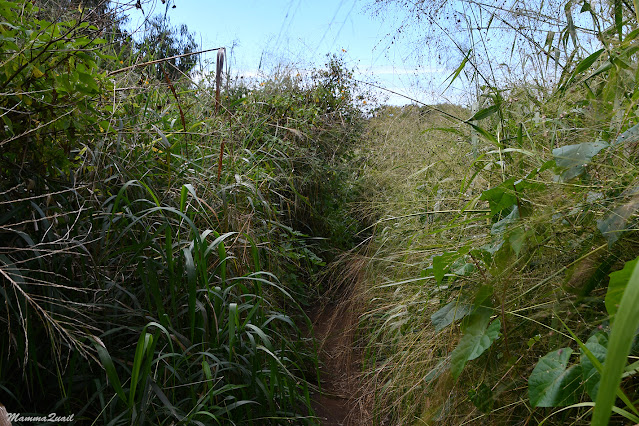
The familiar looking vine turned out to be bitter melon, another Asian crop plant that was introduced to Hawaii and established itself in the wild (and the only vegetable so far that I couldn't develop a taste for).
Bitter Melon, Momordica charantia

The chicken flock in the parking area had grown and I counted more than ten of them, mostly hens and chicks. I took a few photographs but we didn't have the time to linger there any longer. We got into the car and drove off to the Kona airport. We made it there in time to catch our flight.

I think that If I was doing this trip with Pappa Quail and the chikas we probably wouldn't have gone to Captain Cook's monument under the time constraints we've had. It was a very time-tight hike with very little buffer time. I am very glad that we did it though. It was a place I really wanted to see and a perfect end to our time in the Big Island. It was also a reminder that four days is really too little time to see this island's wonders. I want to visit it again.


Monday, March 14, 2022

A Hike To Remember: Kilauea-Iki Rim and Crater at Hawaii Volcanos National Park

Kilauea Iki Crater


Date: January 22, 2020
Place: Hawai'i Volcano National Park, Hawai'i
Coordinates: 19.416857, -155.242891
Length: 3.75 miles
Level: moderate

One of the places we were sure to visit while in the Big Island was Hawaii Volcanos National Park. Pappa Quail and I have been there before on our first visit to Hawaii, and we got to see the lave flow from the Puʻu ʻŌʻō crater of Kilauea Volcano. That lava flow has been going for decades, but is it happened, the volcano went on sabbatical on 2019, a break from eruption that lasted a few good months, including the time of my recent visit there. 

On January 2020, a month BC (Before Covid) I had my second chance to visit Hawaii Volcanos National Park, this time with my friends. There was no live lava flow to see. What else, then? After consulting the rangers at the visitor center we decided to hike the Kilauea Iki trail. That too I've done with Pappa Quail 18 years ago but I remembered very little of it. 

Kilauea Iki is one of the small craters of the Kilauea Volcano, located next to the main Kilauea crater which was the primary lava vent until the late fifties. 

Kilauea and Kilauea Iki craters as viewed from the Mauna Loa View Road

The trail is a loop trail that goes around one side of the rim, and crosses back on the crater's floor. It is a very popular trail and our first challenge was to find a parking place. I knew right then that we won't have the volcano all to ourselves. 

Our hike as captured by my GPS

We started south, making our way toward the nearest entrance to the crater. For the first time since we arrived at the Big Island I was feeling that I was in a tropical region. I think it was the huge ferns all around us.

Lush patches of green moss matted large exposed areas of rocks and fallen logs. I couldn't resist the urge to stroke them, they felt very velvety.

There are vista points along the rim with nice view of the crater below. I forgot how impressive that view was. I could imagine the time when this crater was flowing with molten lava. That must have been quite a sight! Far on the horizon loomed Mauna Loa, the second largest volcano in Hawaii. Mauna Loa's last eruption was in 1984, and the lava flow had reached the outskirts of the town on Hilo, miraculously stopping just before the houses. Mauna Loa, like Kilauea, is a shield volcano, and has a round shape, not the classical cone that is common for stratovolcanos like mount Shasta. It looks quite harmless from a distance. 
Kilauea Iki Crater

Shortly we started descending into the Kilauea Iki crater. All along the side of the trail downward grew a plant that I later identified as Himalayan ginger. It added a very nice color to the hike and I photographed it many times. 
Himalayan Ginger, Hedychium gardnerianum, Invasive

We were too late for its bloom season. The pretty color came from its fruit. Later I also found out that the Himalayan ginger is not an Hawaiian-native plant. It has established itself in the wild there as many ther introduced species did. 
Himalayan Ginger, Hedychium gardnerianum, Invasive

The giant Hapu'u ferns however, are native to Hawaii, an are a strong contributor to the air of a tropical jungle that we were walking through. 
Hapu'u, Cibotium sp.

The young buds of the giant fern look strange and beautiful, like eggs in a nest.  

The trail down to the crater is short and drops quickly in a few switch-backs. Despite the jam-packed parking lot, there weren't too many people on the trail leading down to the crater floor. I assumed most of the other visitors were satisfied with the view from above. 
Kilauea-Iki Trail 

I had my first deja-vu feeling when I stood at the bottom of the trail looking across the crater floor. I knew I was here before, in this very spot. I didn't remember being there until I set foot at the bottom of the crater. Even now, my memory was only feelings and fleeting images in my mind. I was glad to be there again and I promised to myself that this time I will not forget this hike. That's one reason why I write about it here. 
Kilauea Iki Crater

One of the things I did remember was the Ohi'a lehua trees growing on the crater floor. There were many of them around the park's visitor center but it was an altogether experience to see them inside the the volcanic crater, growing on hard, exposed pahoehoe lava, like plants on one of those alien planets depicted in sci-fi shows. 
Ōhi‘a lehua, Metrosideros polymorpha

I was altogether amazed at these volcanic plants growing, even thriving, in a place so harsh. There's hardly any soil there. nearly all hard rocks. And it's hot and exposed, with no surface water at all. There has to be regular rainfall there for these plants to do well there. 
The little Ōhelo shrubs seemed to be hanging on cracks of the lava rocks, their pomegranate-shaped flowers drooping downward. I wondered what pollinates them, I didn't see any insects there.  
Ōhelo, Vaccinium reticulatum

After a few long minutes in which me and my friends explored that corner of the crated and posed for selfies to send our spouses at home we started crossing the crater. The trail was a faint light line marked by the passing feet of numerous humans. It was also marked by large cone-shaped cairns. There were a few people ahead of us but all and all, we were nearly alone inside the crater for most of the time. 


I don't recall seeing any warning about straying off the trail inside the crater. There must be one, I think. I could see many holes in the lava crust and I suspected there might be places in which the crust would be thin enough to collapse underfoot. 

The crater wall looked much smaller from below. It is sheer and crumbling, certainly not climbing material. Nonetheless, it was very impressive.I couldn't get over the fact that we were walking inside a volcanic crater. It was similar to the filling I had when I went down the crater of the Cinder Cone of Lassen Volcanic National Park. 

About a third of the way across the crater I noticed a wisp of steam emanating from the crater floor near the rim wall on our left. I pointed it out to my friend and watched with astonishment as one of them immediately started walking in that direction. My and my other friend exchanged looks and started right ofter her. I shouted a warning about the nature of that steam and about the risk of a collapsing crust, but my friend merely shrugged and continued on to the fumarole. 
I slowed down, careful to test the ground with each step. Meanwhile I could see that the lava cracks were actually inhabited - little plants were growing inside them.Once again I was impressed with the resilience of the volcano's plant life. 

My friend had reached the fumarole and posed. I cooperated with her and took the photos while horrifying images of the earth opening up and swallowing her had crossed my mind. My other friend and me kept our distance. I said nothing when my risk-taking friend returned. I knew she would have dismissed my concerns altogether. 
Fumarole

The way back to the trail provided some nice sights too. We didn't backtrack, but moved in the direction of the other end of the crater, aiming to join with the trail before it slips between the rock mounds on that end. One of he things we saw was the Ōhelo plants again, and on this side of the crate they were already fruiting. I later read that their berries are edible but even in we did know it at the time, I don't think we'd have tried them. 
Ōhelo, Vaccinium reticulatum

We crossed areas where the pahoehoe lava was replaced with the porous tuff rock. The tuff was also very colorful, ranging from white to rusty red and black. 
Tuff

We run across a few other fumaroles on our way. We didn't know they were there because they were much weaker and their steam barely noticeable until close proximity. They smelled of sulfur, as expected. When I bent down to take a closer look I saw that the sides of the fumarole crack were covered with green algae, and some white deposit that I couldn't tell of it was minerals of bacteria, or perhaps both. 
Fumarole

There were numerous tiny plants growing out of what looked to me like hard rock. Given enough time with no eruption, perhaps these plants will grow and crack the rock enough to create their own moisture-retaining plant bed. 


Some of the plants we've seen appeared to be full grown. At least grown enough to bloom. The pinkhead smartweed had red foliage too: it's an adaptation to high radiation. The presence of the fern indicated that the crevice these were growing in was good in retaining moisture. Perhaps there was real soil trapped under the surface. 
Pinkhead Smartweed, Polygonum capitatum (front) and ferns (back) 

Where we finally picked up the main trail again were some round items bolted to the ground. I wondered if these were the remains of a structure of a sort, or perhaps there were covers for measurement instruments. We were getting hungry but it was hot and exposed. I suggested having a break at he rocky area near the end of the crater where I hoped we might find some shade. 

We did find a tiny bit of shade and sat down to eat and relax. I didn't stay in the shade very long - after bolting down my snack I wondered off to check out some more of the local flora. 
Lilac Tasselflower, Emilia sonchifolia

Little composite wildflowers, very similar to some that I know from California dotted the area were we sat for a break. Similar, but I knew they were different. I don't recall having seen any of these on my first visit to Kilauea Iki. Perhaps they are seasonal. Perhaps I simply don't remember. 
Rough Dubautia, Dubautia scabra 

The west side of the crater isn't flat but very bumpy with piles of broken lava crust. It appears that this was the last part of the crater to have solidified after the last eruption. It was easy enough to tell where the last flow of molten lava moved through at the time. 
Ōhi‘a lehua, Metrosideros polymorpha

We took our time going through that area. For one, there were more people there and trying to take human-free photos became a bit more challenging. On the other hand, my friends were thrilled with this place and wanted to pose for photos themselves and also to explore some of the cracks of the old lava stream. I, as always, was fascinated with the vegetation, such as this very exposed, and likely very dryness- and radiation- resistant fern. 
Amaʻu, Sadleria cyatheoides

When we started ascending the western wall of the crater rim we got a better view of a big chasm on the left side. It seemed much more lush there, in that shadier area and probably more moist as well. There were a few people down there and for a moment I regretted not going down there myself. 

I got quite excited when I saw an orchid blooming a bit off the trail. I went there to get a close up of the flower, which was already past its peak. Later I found that this orchid wasn't a Hawaii native but an introduced species that established itself in the wild there.  
Bamboo Orchid, Arundina graminifolia, Non-native

Soon after we begun ascending the crater wall we plunged once again into the tropical forest, surrounding ourselves with dense greenery. Much of these plants I later learned, were invasive species that found a good home in Hawaii. 
Yellow Himalayan Raspberry, Rubus ellipticus 

All these plants however, both native and introduced, were new to me. I enjoyed much the discovery of wildflowers and the variety of shapes and colors. Again, I was surprised at not seen very many pollinators. Non at all on the crater floor and very few insects above, at the rim. 
Greenleaf Ticktrefoil, Desmodium intortum

It was a short way up. Within a few switchbacks we were at the top once again, and started our way back along the north side of the crater rim. There were less flowers there at the top, and many more ferns. I really like the coiled spiral of the young fern buds. 

The north rim trail wasn't level but undulated up and down. At one of the higher spots we got a glimpse of the larger Kilauea Crater, the same one that Mark Twain had seen when it was full of molten, boiling lava. The crater was completely solid now, of course, but numerous fumaroles were sending up their steam in white tufts of vapor. On my pervious visit there with Pappa Quail he had spotted some white-tailed tropic birds flying above that crater. I remembered it and I looked for them now, but didn't see any. Perhaps their presence there is seasonal. Perhaps they were simply avoiding me. 
Kilauea

A strange looking plant caught my attention. I've never seen anything like this, a clubmoss, before. I hovered over it for some time until I had to run off and catch up with my friends.  
Wāwaeʻiole (Staghorn Clubmoss), Lycopodiella cernua

The tropical feeling conferred by the ferns was much less intense when I looked u at the forest canopy. The trees looked like oaks but looking back now, I cannot remember if these actually were oaks. It reminded me some of the oak forests in the East Bay, though. 

At a vista point on the rim we got to see the crater from above once again, this time looking southeast. I could see the trail crossing the crater and the tiny people on it, like colorful beads on a string. There was alight brown spot at the bottom, closer to our side. I didn't see it from inside the crater and I wondered what that was. 
Kilauea Iki Crater

I took a close up photo of that light brown spot and it looks to me like another spot where the lava remained molten until the very end when the flow just crusted all around it. 

Moving on along the north rim trail we once again were surrounded by the tropical forest, and yet another species of ferns. 
Uluhe, Dicranopteris linearis

The last bit of trail leading to the parking area was uphill. I welcomed the sight f the giant ferns as I run up the wooden stairs, catching up to my friends 

After finishing the hike we decided to drive up to the Mauna Loa area of Hawaii Volcanoes National Park. There was a view point on the mountain there, and a trailhead where backpackers go up Mauna Loa begin their trip. The road was very narrow and winding and we had to take it slow also because there were numerous pheasants and other chicken-like fowl roaming near or on the road. Every time I tried to photograph any though, they would scatter away. I ended up with very few photos that were in focus. 
Erckel's Francolin 

When we finally reached the view point and the Mauna Loa trailhead, we realized that we had very little daylight left for us to hike. We did some walking along the trail to see what we'd find there. The Koa acacia trees were one of these finds. I love acacia bloom. 
Koa, Acacia koa

Another nice find was the Māmane, another endemic Big Island wildflower. 
Māmane, Sophora chrysophylla, endemic

Mauna Loa, a shield volcano, has a very mild slope. From where we stood we could not see its summit. There was no telling that there was any end to this mountain at all, it seemed to be going on forever.  Looking down though, we could see the Kilauea Crater, with the Kilauea-Iki next to it, where we hiked earlier. That's the second photo in this post, just above the hike map. 

We made our way back to the car, said hello to the couple of hippies that were car-camping at the trailhead, and started back down the road. It was dark by the time we exited the park, and quite late when we finally arrived at our lodge. It was a full day of great Hawaiian nature, and a beautiful, memorable hike.