Date: May 2015
Place: Mt. Diablo State Park, Clayton, California
Coordinates: 37.920359, -121.941730
Length: about 2.2 miles
Level: Easy
Ever since I found it, Mitchell Canyon has become a pilgrimage site for me. Every year when the month of May rolls in I make it out there, alone or in the company of family and friends. This year I was fortunate to hike there several times and, like in
earlier years, it was Nature galore.
The pleasure begins even before the hike: right by the visitor center
there is a beautiful botanical garden of native Bay Area plants. I was
tempted to wander in the garden before and after the hikes. I
appreciated the nicely arranged sections and the signs naming each
plant. Many were blooming at the time, and I enjoyed each and every
flower.
 |
| California Poppy (Eschscholzia californica) |
The trail I hike there is the same every time: going up (southwest) Mitchell Canyon and looping halfway back on the Globe Lily Trail. The whole thing is just under 2 miles of easy walk, dense with wonderful Nature views and interesting sights and encounters.
 |
| My Mitchell Canyon hike as captured by my GPS |
May usually is wildflower galore at Mitchell Canyon. This year I've had some concerns it might be too late - the drought brought about the bloom much earlier and I've seen online postings of the famous Mt. Diablo globe lilies as early as March. I feared that by May all will be over.
My fears dispelled when I embarked on the hike when just a few steps into the trail I run into a cluster of larkspurs, standing out with their velvety purplish-blue against the light-green grass.
 |
| Larkspur (Delphinium sp.) |
Some landmarks along the trail are already quite familiar to me. Like the bicentennial tree (a large, majestic oak a bit off to the north of the trail, and the nearer, smaller oak that's closer to the path. That oak carries a load of fresh galls each year - perhaps that's why it doesn't get bigger.
 |
| Oak Galls |
The galls are growths induced by a wasp laying her eggs in the stem. the larvae produce cytokines that promote the growth of a tumor. They feed on the tree and are protected inside it from predators
(but not from a utility knife).
 |
| Wasp Larvea inside an Oak Gall |
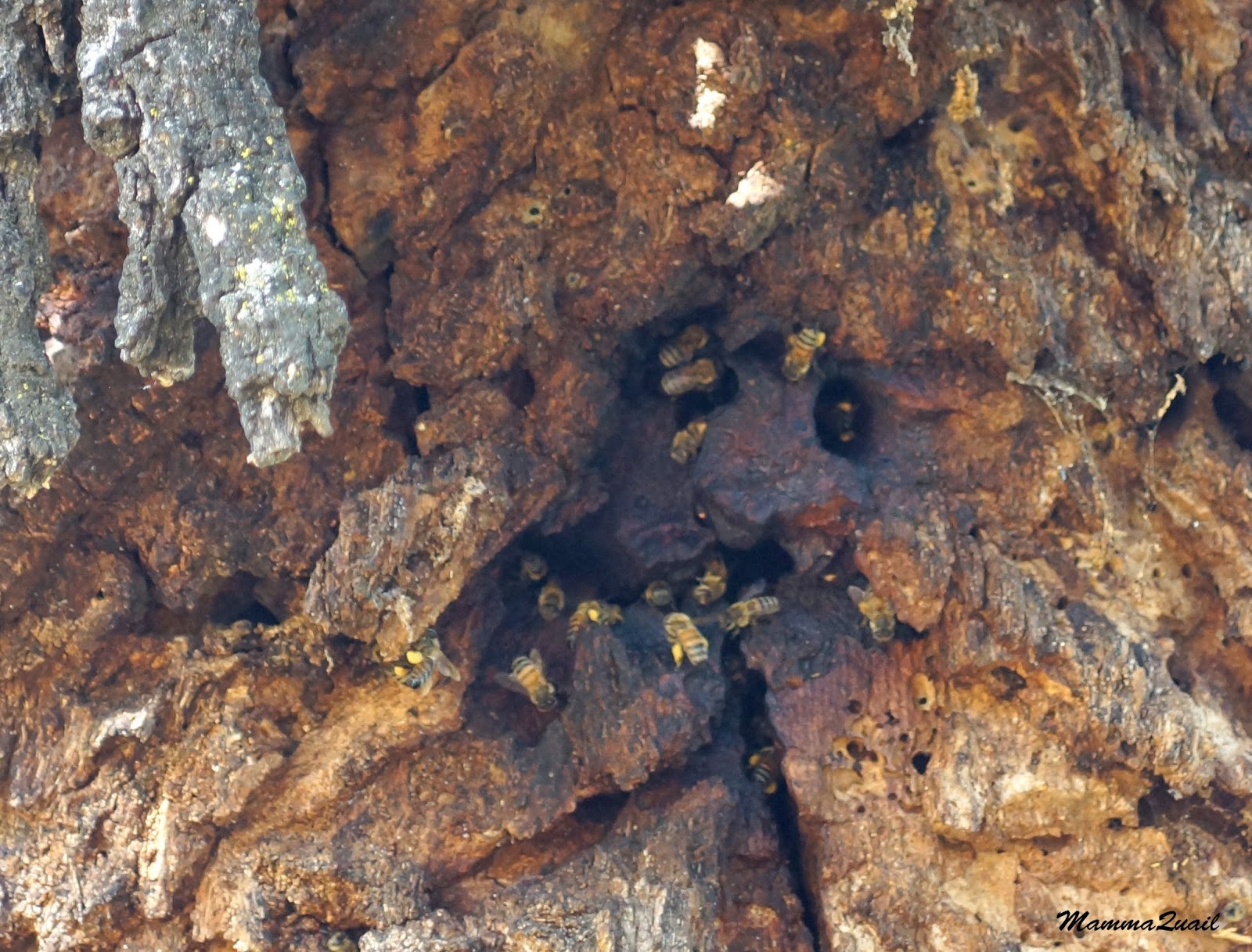
Another interesting find is a hive feral honey bees. Honey bees were introduced to California by European-descent settlers who used the bees to fertilize crop plants. Runaway queens can establish feral hives. This one has been there for at least two years. I was surprised at how quiet these bees were, and how little attention they paid us humans who watched them with fascination for quite a while. I guess that bees resident of a hive that's not being routinely raided have no reason to be angry.
 |
| Feral Honey Bees |
The vegetation at Mitchell Canyon is riparian - meaning the biggest, densest and lushest grow right along the creek where water is less limiting. Many water-loving buckeye trees grow along the creek, and they were not at all coordinated in their blooming stages.
 |
| California Buckeye |
The trail goes in and out of the trees shade. The shadiest are the beautiful live oaks with their wide, dark canopies. Other oaks are also present along the trail. Together with the buckeye and the coulter pines
they create a deep forest atmosphere, even if for a relatively narrow strip. 
Mout Diablo is the northeast border of the Coulter Pine. These beautiful trees bear heavy cones and the tastiest pine nuts I have ever ate. And yes, I an shamefully collecting these pine nuts whenever I see them (but only on the trail itself).
 |
| Pine Cone |
Mistletoe is a common occurrence on Bay Area trees. Mostly I see them as puffy balls on oak trees. This time I had the opportunity to see it's humble beginning as a new parasite on pine branches.

There weren't many flowers on the shaded part of the trail. The most seen bloom there was that of the sticky monkeyflower,
 |
| Sticky Monkeyflower (Mimilus aurantiacus) |
Soon I arrived at the first place where the Mt. Diablo Globe Lilies can be seen along this trail. As I suspected, most of the plants were done blooming, but not all. There were still plenty of flowers to see and appreciate. And they were blooming still at the end of May too.
 |
| Mt. Diablo Globe Lily (Calochortus pulchellus) |
The earlier bloomers provided the opportunity to see the beautiful lily fruit.
 |
| Mt. Diablo Globe Lily (Calochortus pulchellus) |
Poison oak is very common plant and can be seen on pretty much every Bay Area hiking trail. People should avoid contact with it because it can cause a nasty allergic skin reaction in sensitive people. Butterflies, however, have other considerations.
 |
| Western Tiger Swallowtail on Poison Oak |
There were so many butterflies there, my head was spinning. Some were even generous enough to stand still for a few seconds, enough time to be photographed.
 |
| Variable Checkerspot |
Butterflies weren't the only insects about. In fact, there was bug-buzz everywhere. Not all of them flying, however.
 |
| A beetle - a wood boring species, I think. Any anthologist among my readers? |
The trail is fairly short and easy, but walking it is slow. Very slow indeed. There's simply so much to see!
And there is a bench, right at the trail intersection. And once making the turn - more things to see.
 |
| Mission Blue Butterfly |
At the bench I turn right, and immediately right again onto the Globe Lily Trail - a narrow foot trail that goes up and along the hillside over the canyon.
Mariposa lilies - very close relatives of the globe lilies -grow in abundance along that trail. There are globe lilies there too, but the mariposa lilies outnumber them by far.
 |
| Butterfly Mariposa Lily (Calochortus venustus) |
There were so many of them all along that trail segment. Every step I stopped to photograph 'the perfect lily" until I realized they were all perfect and moved on to pay attention to other wildflowers.
 |
| Blue-eyed Grass (Sisyrinchium bellum) |
Most of these wildflowers I'm well familiar with. I've seen them many times before and enjoy seeing them any time again.
Occasionally though, I see something new to me. Or that was there all along but I've only just noticed. Like this flax, for example.
 |
| Brewer's Western Flax (Hesperolinon brewery) |
Globe Lily Trail doesn't really go up. It is the creek that drops below. The slope of Mitchell Canyon Trail is so mild that one hardly notices the incline, but walking back on the fairly level Globe Lily Trail reveals how high I really did go up.
 |
| Mitchell Canyon, view north. |
Up on the hillside the vegetation is less dense and the trees are further apart. There is a clear view of the canyon's mouth and of the opposite slope. There's a rock there that stands out. I had not realized that there was a trail going there until I noticed the tiny colorful dots of people sitting on top. perhaps on the next time I go to Mitchell Canyon I'll make it up there myself.
Between the sparse trees and on the south-facing slopes there is dense chaparral. This thicket of bushes, rising from knee- to well above my head - height is a thriving home for rich wildlife: lizards and snakes, little song birds and lots of insects and other invertebrates. In past years I've seen there also rabbits and mice and even encountered a California king snake constricting a vole.
The chaparral comprises of many plant species, but the most dominant at that trail segment is the chamise, which in May was blooming furiously.
 |
| Chamise (Adenostoma fasciculatum) |
Bees, hoverflies and other bugs were buzzing in clouds about the chamise. My chikas immediately found the ladybug.
 |
| Chamise (Adenostoma fasciculatum) and a Ladybug |
Other than shrubs, the chaparral has it's own host of herbaceous wildflowers. Several clarkia species among them.
 |
| Chaparral Clarkia (Clarkia affinis) |
These clarkia are small, but their strong colors stand out beautifully against the ocher-colored ground.
 |
| Purple Clarkia (Clarkia purpurea) |
Indian paintbrush is also a common sight along the Globe Lily Trail. They glimmer in the sunlight, reminding me of holiday torches and festive flames.
 |
| Woolly Indian Paintbrush (Castilleja foliolosa) |
To my south - the rising slopes of Mt. Diablo. Had I continued on Mitchell Canyon Trail I could have hiked all the way to Eagle Peak - the lower of the double-Diablo peaks. This hike, however, would have taken me the entire day and, therefore, would have to wait that day dedicated entirely to it.
 |
| Upper Mitchell Canyon |
About mid-trail I hit jackpot: an orchid! Small and green, but still, royalty among wildflowers.
I count several individuals at that trail segment and show them to the people that join me on my later May hikes there. At least one of them visibly shared my enthusiasm :-)
 |
| Royal Rein Orchid (Piperia transversa) |
Eventually the trail curves to the right and starts descending back into the canyon. The slope is north-facing there and the vegetation lusher.
 |
| Creeping Snowberry (Symphoricarpos mollis) |
The more common species of Indian paintbrush is more common there too. At the height of its bloom, it's vibrant red standing out on the green background.
 |
| Indian Paintbrush (Castilleja affinis) |
Also standing out in festive colors - the white blue-eyed Mary.
 |
| White Blue-eyed Mary (Collinsia bartsiifolia) |
That green background is worth a closer look too - at least three fern species in that one picture, all live happily under one shady bush.
 |
| Triple-fern Corner |
And then, just like that, I arrived at the intersection where I turn off the Globe Lily trail. And right there by that intersection - a pretty bushmallow in bloom.
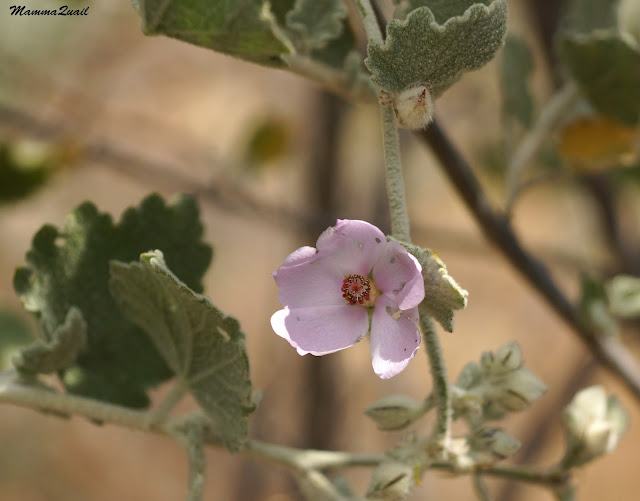 |
| Fremont's Bushmallow (Malacothamnus fremontii) |
It is a very short trail segment that connects the Globe Lily Trail with the Mitchell Canyon Trail, but that short segment held a surprise for me.
On my first May hike I went solo. I walked quietly and with soft steps. And I heard this low whistle from the shrubs to my right. I stopped and looked but saw nothing. The moment I resumed walking, the whistling resumed as well. I stopped again, and this time looked more carefully. To my right, a few feet away from the trail, was a small buckeye surrounded by tall weeds. Underneath the buckeye there was a dark form. I brought the binoculars to my eyes: the dark form had an eye!
 |
| A Wild Turkey hen sitting on eggs |
I figured that was a wild turkey there, under the little buckeye. It could have been an injured bird, but considering the time of year and the nesting habits of wild turkey I thought it more likely to be a hen on eggs. I clicked the camera a couple of times, then wished her success and walked on.
A few days later I was there again, this time with the Redwood 4H Hiking Project. I didn't tell them about the nest - I did not want the hen to be disrupted. But as we were coming down that trail segment I noticed immediately that things have changed: the weeds were all trampled and the nest deserted. Under the buckeye there were 8 cracked eggs and quite a few feathers lying in a mess. I stopped the group and we came over to explore.
There were no signs that the nest was raided. In fact, one of the parents who happens to be a poultry expert, had pointed out that the eggs were hatched naturally and hadn't been cracked from outside.
 |
| Hatched turkey egg |
Among the feathers left behind were quite a few quills, positively identifying the parent bird as a turkey hen.
 |
| Wild Turkey feather |
We
went on on our hike and I was happy to note that somewhere in the area
there was a happy mamma turkey with a brood of (at least) eight chicks.
I hiked that trail thee more times after that until the end of May and each time the ere were fewer and fewer eggs and feathers. By the end of the month there very little evidence that there was any next there just three weeks before.
Meeting the Mitchell Canyon Trail again, I turned left toward the trailhead and the visitor center. Lizards basked in the sunlight and darted away when I came too close for their comfort.
 |
| Lizard (Western Fence?) |
As I descended back toward the parking lot I took the time to enjoy the patches of yellow mustard under the quarry at the Canyon's entrance. The mustard was introduced to California by the Spanish missionaries who sowed to be a marker for the El Camino Real - the way connecting the California Mission. The mustard, along with other exotic species that were introduced since then, have completely transformed the California coastal landscape. To this day the East Bay hills light up in mustard-yellow.

As I'm writing this blog post, fall is coming to an end and winter rolls in, so far with good rains. Last May the creek did not flow at all. Next spring I hope to see it gashing with water. With renewed life.