Saturday, October 17, 2015

The Quiet Side of Bear Gulch

Date: December 25, 2014
Place: Pinnacles National Park, Paicines, California
Coordinates: 36.481344, -121.181452
Length: 1.5 miles one way
Level: moderate

The Pinnacles National Park has been a blazing hot spot for me in the past year and I had opportunities to explore trails a bit outside of the popular areas.
Bear Gulch Cave and Reservoir are very popular attractions to people visiting the Pinnacles NP. The downstream part of Bear Gulch Creek, however, is hardly a hike by its own right. Skipped by most Bear Gulch visitors, this trail segment which connects the cave and reservoir to Chalone Creek, is generally hiked as part of a larger loop hike. This is also how I got to hike that trail. It does, however, an interesting and very beautiful trail that can easily be incorporated into a Bear Gulch Cave hike if started at the campground or the Peaks View parking area.

When I hiked Bear Gulch it was the final segment of a larger loop trail that begun at the Old Pinnacles parking lot, continued up by the High Peaks and descended to the Bear Gulch Parking lot. To get back to my car I needed to go down (east) along Bear Gulch Creek and back up (north) along Chalone Creek. This post is only about that trail segment.
My hike from Bear Gulch to Old Pinnacles
It was already late in the afternoon when I arrived at the Bear Gulch parking area.  And it was 4 days after the winter solstice, meaning I hadn't much daylight time left. So although I was after a good, long hike already, I didn't stop to rest but continued on down the trail along Bear Gulch.
Following two wet months, the creek was flowing nicely and green vegetation grew along its banks.
Hello Mr. Sunshine!
Near the nature center (which was closed at the time) there are large oaks, many of them holed by acorn woodpeckers to be used as granaries. Although I've seen the birds there on other visits, they were somewhere else at the time.
Acorn Woodpecker's Granary
As I got further away from the nature center the trail became very quiet. While there were a few people up by the parking lot, down by the creek I was all alone. Just me and the wilderness.
The trail follows the creek very closely. Many of the plants at the creek banks looked flattened and there were piles of vegetation debris lodged at the turns. Evidence of e recent flood, no doubt.
Deergrass (Muhlenbergia rigens) by the water
Bear Gulch is deep and narrow, and is well shaded under tree canopies. Mostly oak, but also others, such as maple. A thick layer of fallen leaves matted the ground and a deep, earthy fragrance hung in the air.

The damp season is the time for fungi fruiting. While not a spectacle as the NorCal coastal mushroom bloom, Bear Gulch mushrooms were still a much appreciated beauty. 
Bolete Mushroom
And I even saw a mushroom there that I didn't see in the redwoods.

Ferns lined along the entire path. They, too, looked healthy and happy after two months or rain.
Western Chain-fern (Woodwardia fimbriata)
The sun was still up but down in the deep gulch it was already getting dark. The dense oak canopies deepened the shade and the evening chill was upon me.
Canyon Live Oak
I kept striding downstream along the trail. Other than a few little brown birds I didn't see much wildlife there. What I did see, however, was a very interesting sight: large clusters of ladybugs sticking together for warmth.
Hibernating Ladybugs
As the light was fading, taking photographs was becoming more and more challenging. Not wishing to be on the trail after sunset, I hurried down the path.

Eventually the sun was no longer shining into the gulch. I put on my sweater and raced past a beautiful cascade area that really should have been explored with more leisure, but would have to wait until the next time I hike that trail.
Bear Gulch
And then, almost suddenly, I was out of the gulch and in the wide-open Chalone Creek. And it was sunny there still.
Chalone Creek

I very tired by then and was sorely tempted to sit down and take a little rest in the afternoon sun, but I still had over a mile to walk and the shadows were long.
Late Afternoon at Chalone Creek
Indeed, before I got to Old Pinnacles, the sun had set and, all of a sudden, the temperature plummeted.
Dusky Chalone
There was some light still when I made it back to my car but it was already nighttime when I exited the park. I stopped briefly to appreciate the stars-strewn skies and then plunged into the long drive home. Over three months would pass before I'd be back at the Pinnacles. By then, it would have a completely different look and feel.


Friday, October 9, 2015

Second Time and Lots of Charm: Up (and Down) Mount Pinos

Date: August 14, 2015
Place: Mt. Pinos, Frazier Park, California
Coordinates: 34.813477, -119.126516
Length: 4 miles up and down
Level: easy to moderate

Our first attempt to hike up Mt. Pinos was on the 2015 Spring Break, following our visit of Carrizo Plain NM. When we arrived at the parking lot we were met by harsh weather and decided to abort, swinging by the west Pinnacles on the way home.
Last August I had the opportunity to go back to Mt. Pinos, this time without Papa Quail, who was away on separate business. The chikas and I were returning north after visiting friends in Southern California. I planned to cover the distance in two days, one for a hike and the next for the beach. The night between I wanted to camp at the Valle Vista Campground.
Mt. Pinos is 8,848' high and can get a fine winter snow cover that attracts area cross-country skiers. The road pavement up the mountain ends in a base camp parking lot, about 2 miles shy of the summit.
Last April the lot was deserted. When I arrived there on August 14, there were many trailers and RVs parked about in no apparent order, and in between the vehicles stood numerous telescopes of various sizes. That night would be the third in a row that a strong meteor shower was expected.

By the time we arrived at the parking lot of Mt. Pinos, 2 miles shy of the summit, the chikas were in hearing Nature's call quite loudly. The long line of porta-potties that I saw there on April was gone so, ignoring the red patch of scarlet bugle penstemons by the parking lot, I  hurried the chikas down the 200 yards' path to the nearby campground.
I didn't ignore them on the way back: Scarlet Bugler Penstemon (Penstemon centranthifolius)
I probably wouldn't have mentioned our little restroom diversion if not for two things, one being the nasty litter of human waste around the parking lot (goddamit! the restrooms arejuast 200 yards away! and even if you cannot hold it that far, you shouldn't be leaving it out like that! Bury it and pack out the toilet paper! Yuck!)

The other reason was quite a nice surprise and that was a sole yellow-flowering penstemon that stood out in a field of regular red ones. Because we were in a hurry to get to the campground I took just a quick photograph, hoping to take better shots on our return. Unfortunately on our way back to the parking lot and trailhead I was too busy trying to resolve a conflict between the chikas and missed that unique specimen.
Penstemon sp.
Back at the parking lot we got our backpacks and started up to the summit. The trail is a broad dirt road that's easy to follow all the way up. We went up and down that same trail.
Our hike from Mt. Pinos Base Camp (the right end) to the summit (the left end) marked in yellow.
The altitude isn't a problem there and the trail ascends in a mild slope through an open forest of (mostly) pine trees.

Still, the chikas started complaining almost from the start. We didn't even make it to half a mile before we had to stop for them to rest and snack and for me to breath deeply and say 'ohm' a lot.
A great place to take a break

A good, natural forest showcases quite a few tree personalities. While oaks are usually more expressive, the pines of Mt. Pinos can be quite wild in appearance too.

Within a mile the trail leveled almost completely and we walked out of the woods and into a large meadow painted intense yellow with rabbitbrush.

There are several species of rabbitbrush in that area, and I believe I have identified two of them in that meadow. The differences are slight, making it a challenge to tell the species apart.
Parry's Rabbitbrush (Ericameria parryi) and bee
There were many bees about the rabbitbrush, all of them solitary bees. Younger chika was a bit worried about them, but I reassured here that the bees had no interest in her whatsoever. They were into rabbitbrush, not roses.
Stickyleaf Rabbitbrush (Chrysothamnus viscidiflorus) and bee
We did not see any actual rabbits there, although I'm quite sure they were somewhere around.
Bees weren't the only creatures with interest in rabbitbrush. Elder chika found a big caterpillar chewing on the plant. 

Although the trail was much easier we had slowed down considerably when crossing the meadow. There was so much to see there! Although not as high as the Sierra Neveda, Mt. Pinos is high enough for having an excellent bloom in mid-August.
Bunchleaf Penstemon (Penstemon heterophyllus)
There were quite a few lupines in that meadow, well spaced between the rabbitbrush. Some of them were already past peak bloom.
Pacific Lupine (Lupinus lepidus)
And others were still going strong.
Sickle-seed Lupine (Lupinus albicaulis)
A narrow  trail split off the main trail and lead to a nearby hilltop. I beckoned the chiks and we followed the trail to the tip.
A perfect meditation point
While I would have loved to sit there quietly and contemplate, the chikas were restless and after looking around a bit we strolled back to the summit trail and continued up.
Rabbitbrush is the perfect color match for Indian Paintbrush
Rabbitbrush is a perfect color partner to any other flower color. Every color pairing works with it.
Tall Stephanomeria (Stephanomeria virgata var. pleurocarpa)
As we went on the chikas started another argument that quickly escalated in tones. I hurried to find a suitable diversion for each of them. Elder chika would have been happy to find me birds to photograph, but none of the happy chirpers in the brush would show themselves so she settled for looking for gems.
Not a gem, but pretty and shiny nonetheless.
We passed another patch of forest and entered a second meadow area, where the plants were much lower, stretched on the ground in flat cushions, as common with Alpine plants.
Kennedy's Buckwheat (Eriogonum kennedyi)
Even the lupines there were small and flat. In contrast with their lower-altitude relatives, they had just begun blooming.
Brewer's Lupine (Lupinus breweri)
We were very close to the summit when my elder chika sat down and said she would not go any further.
We sat too. Had a little snack and rested.
When it was time to go on, she got up and continued without a protest.
At the summit there is a small parking area that looked like it has not been used in a long while. There were also benches and information post signs.
And there was view. Wonderful view.
At the Summit - View to the southwest
The chikas slumped on one of the benches while I walked around, reading the signs and enjoying the view.
Double-Tree (triple, actually)
And there were flowers at the summit, too. A beautiful one that I've seen many of - the delicate prairie flax.
Prairie Flax (Linum lewisii var. lewisii)
An antenna-bearing second peak, very close in height was just a short distance east of the summit. I prompted the chikas to move and, without staying to listen to their groans, I hurried to that second peak, where I found the view just as appealing (and less so the half-empty beer can that was left there by a previous visitor).
At the Summit - View to the southeast
It was all downhill from there. After duly taking our own photos at the summit we started back on the same trail we came up on.
And I was just as attentive to the flowers as I was going up.
One-seeded Pussypaws (Calyptridium monospermum)
It is my habit now to try and document every flower I see on the trail. One never knows which flower will turn out to be an interesting find. Even the simplest-looking flowers may turn out to be unique. 
Heermann's Lotus (Acmispon heermannii)
And then, there are those flowers that you know are unique right on the spot. It was only in the way back that I found the flower that made my day: a Mariposa Lily!
With seconds the entire attitude of the chikas changed a 180 degrees and happily, they spotted many more lilies for me to photograph. I couldn't believe that I had missed them on the way up.
Plain Mariposa Lily (Calochortus invenustus)
We had a much better time coming down the mountain than we had going up. The chikas had ceased their bickering and at last, were engaged in the beautiful Nature that we were walking through.
Gooseberry (Ribes sp.)
And so they found the only vertebrate on the trail that was out long enough to get on camera, if only at a distance and in the shade.
Chipmunk
Coming down the mountain was (surprise, surprise!) much quicker. But not too quick to pay attention to the interesting-looking trees along the way. Some trees that looked plain on the way up were showing a completely different side of their personality from the other direction.

We slowed down again as we approached the base camp. Although eager to get back in the car, the chikas needed some rest (this time for real). That final break allowed me a few minutes more to absorb the mountain forest air.
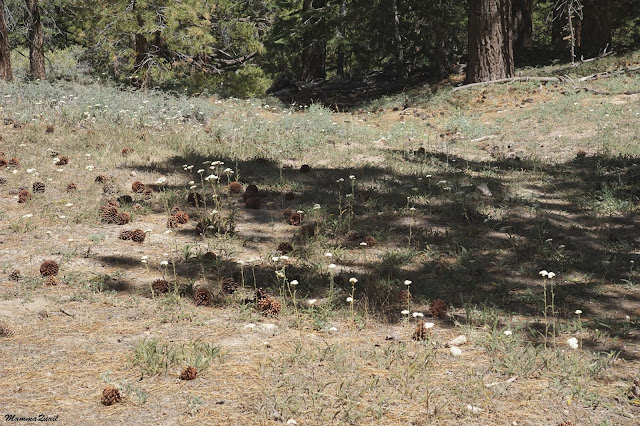
Common Yarrow (Achilea millefolium)
Back at the parking lot I waved farewell to the stargazers, wishing them good sightings and hoping that they'll bother taking the trail to the campground's restrooms and won't deposit any additional waste near the parking lot. 

After leaving Mt. Pinos I drove leisurely west to the Valle Vista campground. The view of the valley was stunningly beautiful indeed.
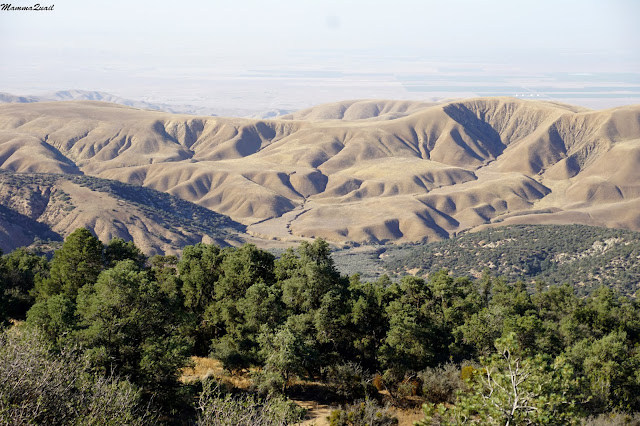
View northeast from Valle Vista Campground
The campground, however, was in a sorry state. The dirt road was all eroded and pot-holed, making it very difficult access to a none 4x4 to get down there. The lower part of the campground was completely inaccessible to us because of the road condition.
The upper part was filthy with trash that was left behind by people with absolutely no regard of Nature whatsoever. And when we did manage to find a side that was sort of acceptable, we discovered it was already occupied by a multitude of fire ants. So after taking a few photos of the beautiful valley we went back into the car and continued on westward, hoping to find another campground.
View southeast from Valle Vista Campground
The next campground we found, at Aliso Canyon, looked much more promising. It is quite desolate, and when we were there it looked cleaner. I already pulled the tent from its case when some of the other campers pulled out a rifle and started shooting  at something. I hurriedly stuffed the chikas and the tent into the car and took to the road again. By then it was too late to find another campground. We crashed in a hotel room in Santa Maria.
The following day we had a fantastic time at Oso Flaco State Park and Beach that completely eliminated all the bad taste that was left from our failed camping attempts.


Wednesday, September 30, 2015

Taking the Long Way: From Old Pinnacles to Balconies

Dates: April 8 and 14
Place: Pinnacles National Park, Paicines, California
Coordinates: 36.494948, -121.172994
Length: 5.2 miles
Difficulty: moderate (passing through the cave requires flashlights and can be challenging to some)

Spring time is the optimal season to visit the Pinnacles National Park, and last spring I was fortunate to visit there several times. On two of these visits I hiked the trail from Old Pinnacles Road at the east side of the park to the Balconies Cave (and back). On the first hike I was on my own. A week later I was there with a group of families. On both hikes I had a superb time and the photos in this post are from both dates.
My Old Pinnacles to Balconies hike as captured by my GPS. 
After our untimely return from our 2015 spring break vacation Papa Quail decided to stay at home with the chikas and sent me off on my own to complete my vacation elsewhere. After been there on the previous day, I chose to go back to the Pinnacles National Park and get properly immersed in its Nature before taking my hiking group there on the following week. 
It was already afternoon when I arrived at the park and it took me some time to find a campsite - there were only a few vacant ones left. So by the time I started my hike the shadows were already getting long. 
At the trailhead
The entire hike is inside the Chalone Creek. The trailhead is at Old Pinnacles Road and has limited parking and no water or toilets except for a single porta-potty, so it is best to get ready in the Visitor Center area and arrive early enough at the trailhead to find a parking spot.
Bindweed (Calystegia sp.)

The trail itself is easy to walk. Wide, clear, and only mildly sloping as it gets nearer the Balconies. All along, the trail is within the Chalone Creek. Wide and sunny at first, the open creek bed is lined with riparian vegetation, including large oaks and pines. Wildflowers were everywhere along the path, unaware that the spring bloom had supposedly peaked a month ago. 
Wind Poppy (Papaver heterophyllum)
Before long the creek narrowed and I was walking in a deep gorge lined with steep rocky slopes that were covered with moss and lichen and patched with wildflowers.

Trees lined along the creek, casting cool shade on me and on the herbaceous vegetation below. In a hot Pinnacles day, the shade was a blessed thing.
Sticky Cinquefoil (Drymocallis glandulosa)


Not only flowers - there were many butterflies about. While I didn't get any gd butterfly photo, I did manage to photograph their much slower offspring: 

Chalone Creek was flowing still. Not much, but enough to enliven the scenery. Where the trail crossed the creek I stopped to inspect the vegetation. 

A common find near running water: the yellow monkeyflower. There  were a few of them right there, by the water. 
Common Yellow Monkeyflower (Mimulus guttatus)
Another nearby little yellow flower: a violet. There are quite a few yellow violets in California and at the Pinnacles. They look similar enough to one-another so I cannot tell the species of the one posted here by looking at six-months old photos.
Violet (Viola sp.)
Other flowers I saw there were much easier to identify.
Canyon Clarkia (Clarkia epilobioides) 
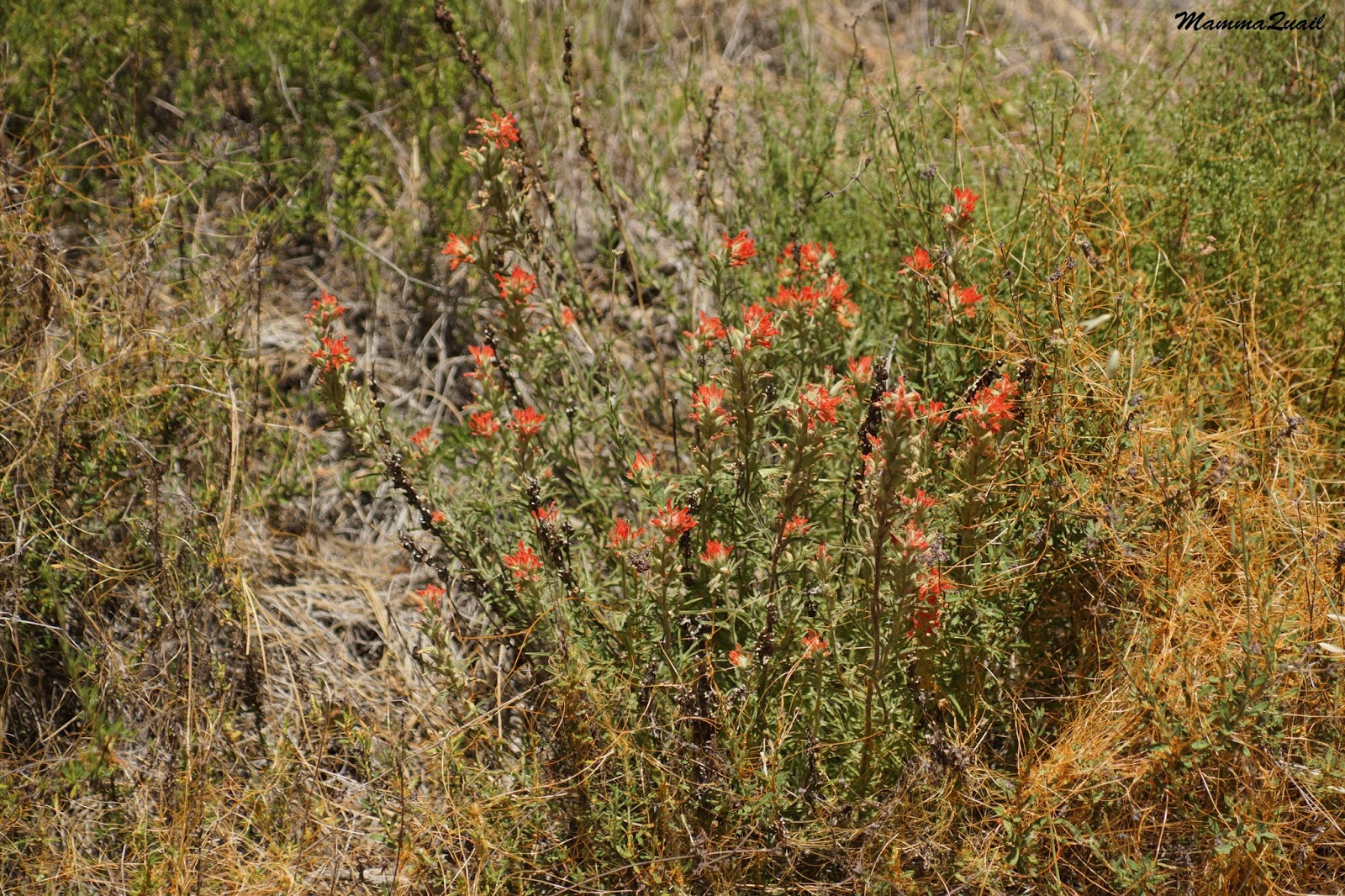
About mid way to the Balconies, the trail comes under full sun for a while. There I found more chaparral-like vegetation, including the familiar Indian Paintbrush.
Indian Paintbrush (Castilleja affinis) 
That yellow, stringy stuff surrounding the indian paintbrush is a dodder plant - a parasitic, non-photosynthethic plant that sucks the life out of other plants. I saw a lot of dodder in the past year and I was sad to see it at the Pinnacles too. Part of Nature's cycle, I know, but also indicative of the environmental stress there.
Chaparral Dodder (Cuscuta californica)
Many lizards were sunbathing on rocks. They didn't even bother to skedaddle as I walked by. Here is one of them:
Western Fence Lizard
Crossing the creek again I came by a patch of white-flowering lupine. There are a few species of lupine with white bloom, but none of them listed in the Pinnacles area. There are also albino versions of normally blue species. As I am not sure which is this one, I leave it unnamed.
Lupine (Lupinus sp.) 
I continued with the trail, again under the shade. Mostly. Large volcanic rocks towering above the creek marked my nearing the Balconies.

And below: more flowers. Some I had not yet seen on the eastern side of the trail. Like this Golden Brodiaea.
Golden Brodiaea (Triteleia ixioides)
Or its relative - the Mexicali Onion.
Mexicali Onion (Allium peninsulare) 
Another familiar one - the common yarrow - I've seen it all along the trail. It was in full bloom and looked very inviting. For pollinators too.
Common Yarrow (Achillea millefolium) 
The rocky towers became larger and more distinct. I was getting very close now. As I often do (and by far not the first one to do so) I saw shapes in the rocks.
The Rhino
And all of a sudden, I found myself in familiar settings: the eastern intersection of the Balconies Loop Trail. 
The Balconies are most commonly accessible from the west side of the Pinnacles. The place I was at usually the half-way point. This time I was doing it the other way around.  
In the Neck of the Woods
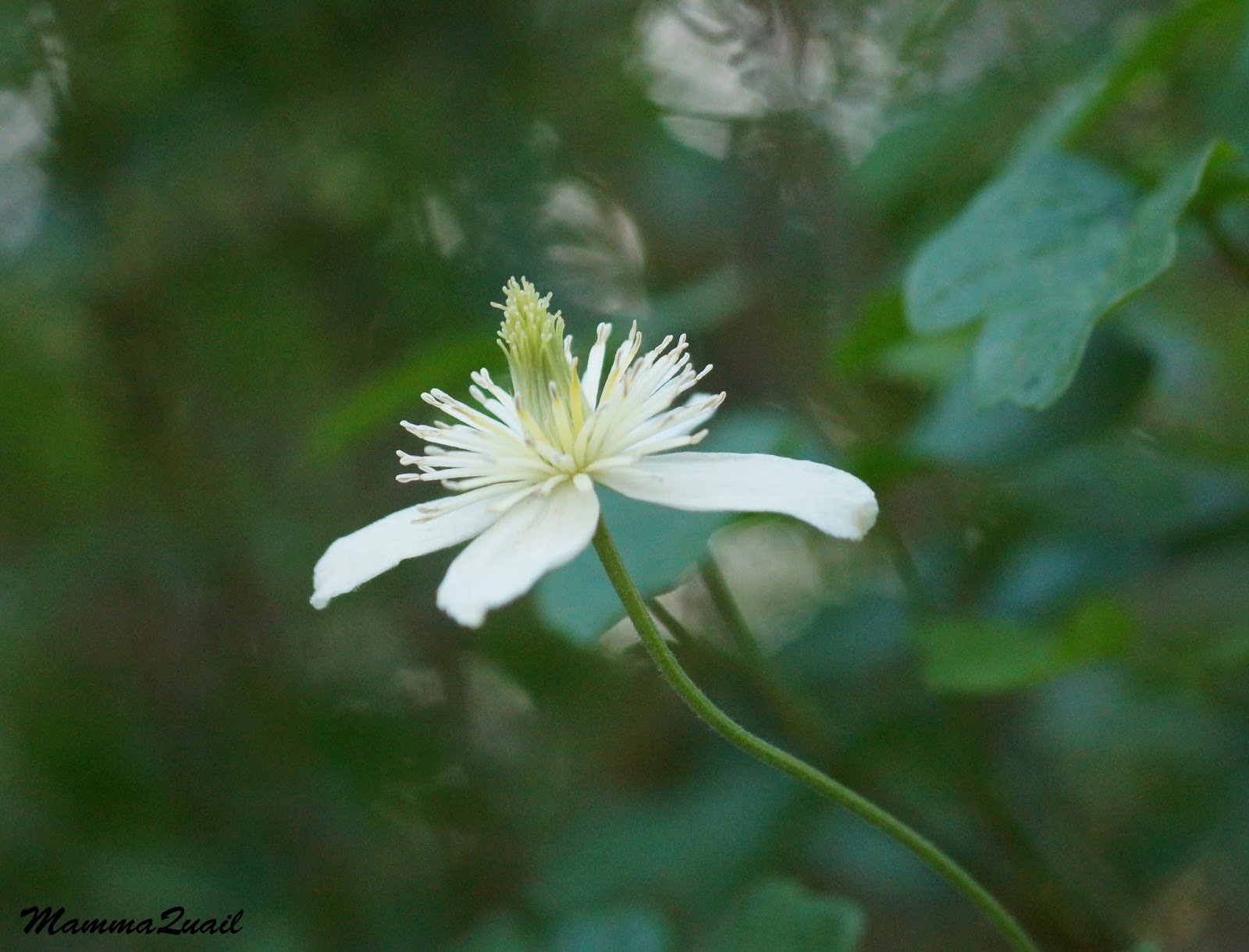
On my former post about the Balconies Loop I showed a photo of fruiting clematis glowing in the sun. The clematis was there last April, too. The same plant. Now in bloom :-)  
Chaparral Clematis (Clematis lasiantha)
There is a low stone retaining wall there, right where the trail splits. That's a perfect spot to sit and relax before going on. 
California Manroot (Marah fabacea)
Then it was time to plunge into the cave. 
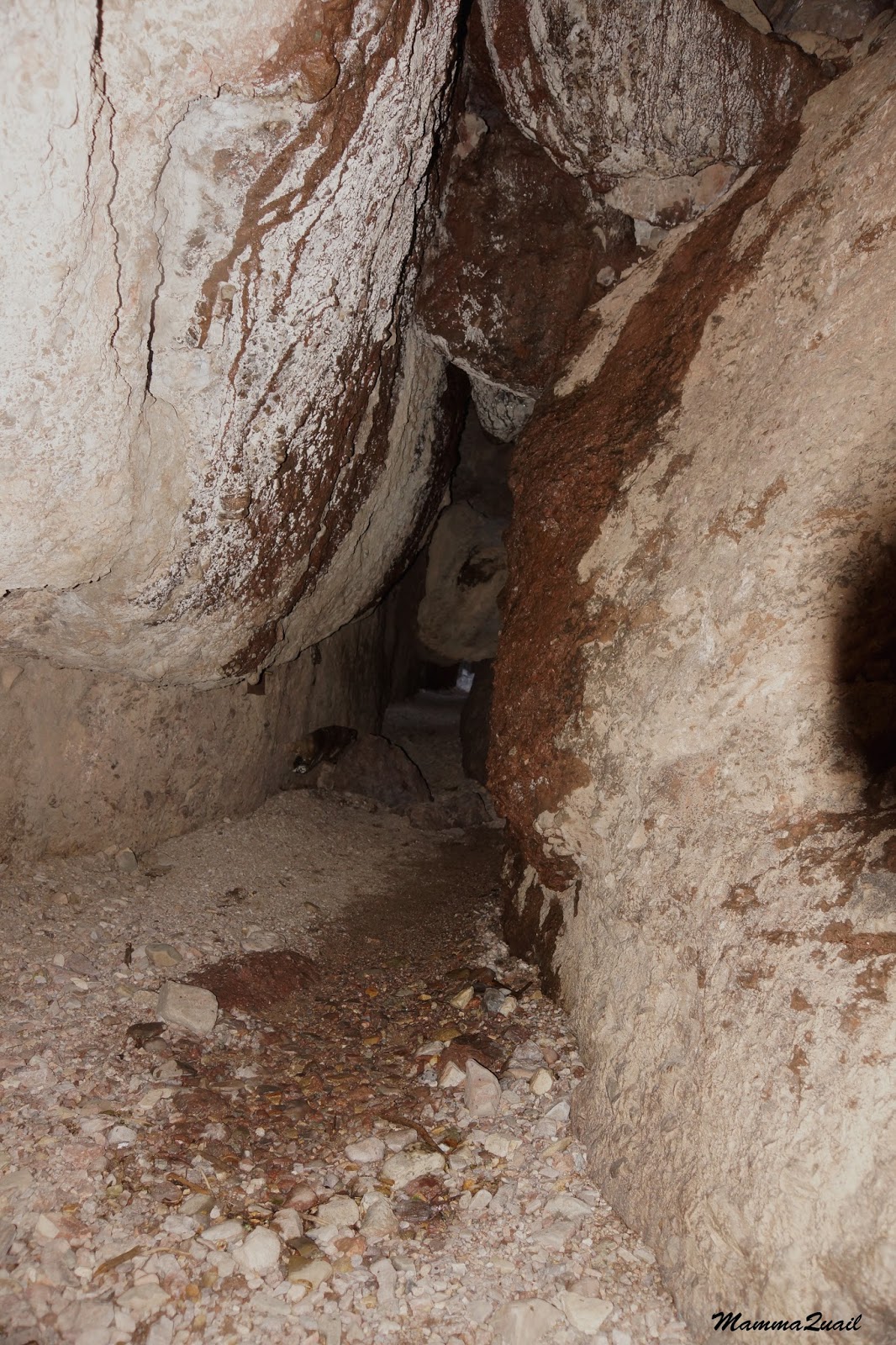
The caves at the Pinnacles NP are talus caves. That is, caves formed boulders fell atop the narrow gorge, thus creating a ceiling. There are two such caves in the park, one in the Bear Gulch area, and the other is at the Balconies, and the Chalone Creek runs through it. The Balconies Cave is the more challenging of the two, requiring some good rock scrambling in the dark. A good flashlight is necessary, a head lamp strongly recommended. At some points it would be good to take the backpack off in order to squeeze through. Babies should be held in a front pack or on hand and not on a back carrier.  
Eastern (downstream) opening of the Balconies Cave
The cave is gated on both ends. Seasonally, the cave will be closed to allow migratory bats some peace and quiet in there. On April it was open and the gate was open. 
And in the corner of the gate - a bird's nest. The nest's owner wasn't there. A pigeon, perhaps? 


There were some recent rains before I was there and the cave was all wet at the bottom, and dripping from the top in some places. Not that I needed the camera there, but I still had to shove it inside my short to protect it from the water. 
The Balconies Cave
A week later, when I was there with my group, the dripping had stopped almost completely, leaving only wet patches on the cave walls and puddles where the creek flowed.  
Outside the cave on the west end the canyon walls stretched on, endowing deep, cool shade that was completed by the trees on the other side.

Oaks, pines, and also California buckeye that was just starting to bud out its candle-like inflorescence. 
California Buckeye (Aesculus californica)
Below: shade-loving wildflowers. The elegant-looking hedgenettle and the very common blue fiesta that carpeted the small alluvium slopes at the rock base.
California Hedgenettle (Stachys bullata)

The blue Fiesta was so prevalent that I was sure it was an invasive species. It is California-native, however. A very pretty one with a (relatively) short season.
Blue Fiesta Flower (Pholistoma auritum)

Shortly beyond the cave's west opening there is the west intersection with the Balconies trail. This time I didn't stop for a rest: it was already getting late. So immediately I begun to ascend the switch-backing trail uphill, stopping only occasionally to photograph the upper rock vegetation.
Broadleaf Stonecrop (Sedum spathulifolium)
The Balconies, like the rest of the Pinnacles famous rock formations, are the remains of an eroded old volcano. The layers and conglomerates of volcanic ash and stones present a colorful and very impressive backdrop for the area's living Nature. Like the tall pine trees, for example. 
The vertical creases that run from top to bottom were cut by water running down the rock face. I wish to see them running in person one of these days!
The Balconies
The trail doesn't go all the way to the top rocks. After a short ascend, the trail levels out at the base of the Balconies rock. There, vegetation is chaparral.
Sticky Monkeyflower (Mimulus aurantiacus)

A very common chaparral member is the chamise bush. On April it was blooming, too. A very delicate white bloom, giving the bush an angelic air.
Chamise (Adenostoma fasciculatum)
Up on the Balconies there was still plenty of direct sunlight. As spirit-uplifting were the little yellow sun-like composites that were shining back at the sky.
Brewer's Ragwort (Packera brewri)
Up there I also got a closer view of some of those giant boulders that covered the creek below. I'm glad I wasn't there when they toppled from the mountain.


I walked down to the east trail intersection and turned left, heading back to the Old Pinnacles trailhead. 
Sunlight was waning fast. In the shaded trail segments it was already getting dark. I increased my pace. On the following week, however, when repeating that same trail with my group, I had more time and much more light to photograph what I had skipped on my solo hike. 
Sanddune Wallflower (Erysimum capitatum)
And it was also on the latter hike that the kids had found an interesting sight: a pair of beetles celebrating spring.

But on my earlier hike there, it was already quite late when I made it back to the Old Pinnacles trailhead. But the Indian tobacco I'd seen there, which was closed when I started my hike, had opened fully. Later that night I saw more tobacco bloom at the campground. Leave smoking associations aside,it is a very beautiful flower indeed.
Indian Tobacco (Nicotiana quadrivalvis)


With just enough daylight left, I made it back to the parking lot and took some time to sit on  large rock and relax before driving off to the campground. The morrow would be a long day: I was planning to go all the way up to the high peaks and I could use a good night sleep.
Black Sage (Salvia melifera)